
Proprietary deal flow is not a network. It is a system. The buy-side firms that consistently close off-market deals are not the ones with the largest teams or the deepest broker relationships. They are the ones who have built a repeatable engine that surfaces targets early, qualifies them against a thesis, times the first conversation correctly, and then tests whether the deal survives diligence before any capital is committed.
This distinction matters because most content on the subject stops at “build relationships and be responsive.” That advice is true and almost useless. Proprietary share of mid-market PE acquisitions has hovered around 40% for years, and it is not distributed evenly: a small group of firms capture the majority of it, deal after deal, and they do it on purpose.
This guide sets out how that engine is actually built: the four channels that produce deal flow, what each one really costs per closed deal, where each one fails, and the diligence test that separates a proprietary pipeline from a pipeline that merely looks proprietary. It assumes a mid-market or lower mid-market investor, including special situations and family capital, whose scarce resource is not targets but deals that survive scrutiny.
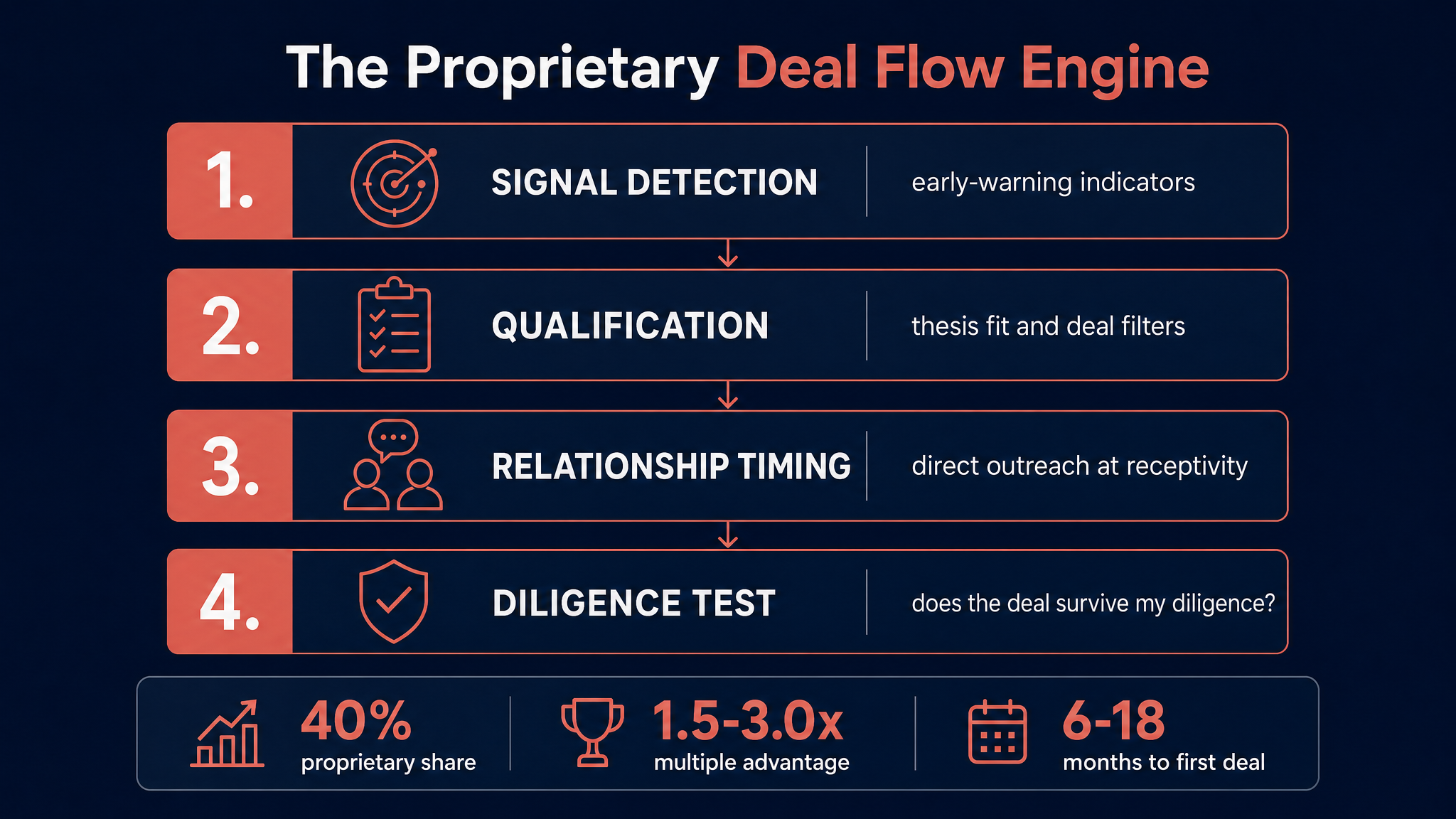
Why “More Deal Flow” Is the Wrong Objective
A firm that doubles its target list does not double its closed deals. It doubles its screening cost, dilutes attention across unqualified situations, and ends up with an origination function that reports activity but not outcomes.
The better objective is narrower and harder: increase the number of deals that reach a signed LOI and clear diligence. That reframing changes every downstream decision. It means qualifying before outreach rather than after, measuring conversion rather than contacts, and treating a pipeline full of targets that fail diligence as a cost centre wearing the costume of an advantage.
The Four Sourcing Channels, and What They Really Cost
Every proprietary deal can be traced to one of four channels. They are not interchangeable, they do not produce the same quality of opportunity, and they do not cost the same. The firms that underperform usually over-invest in one channel because it is the most visible, which is almost always the auction.
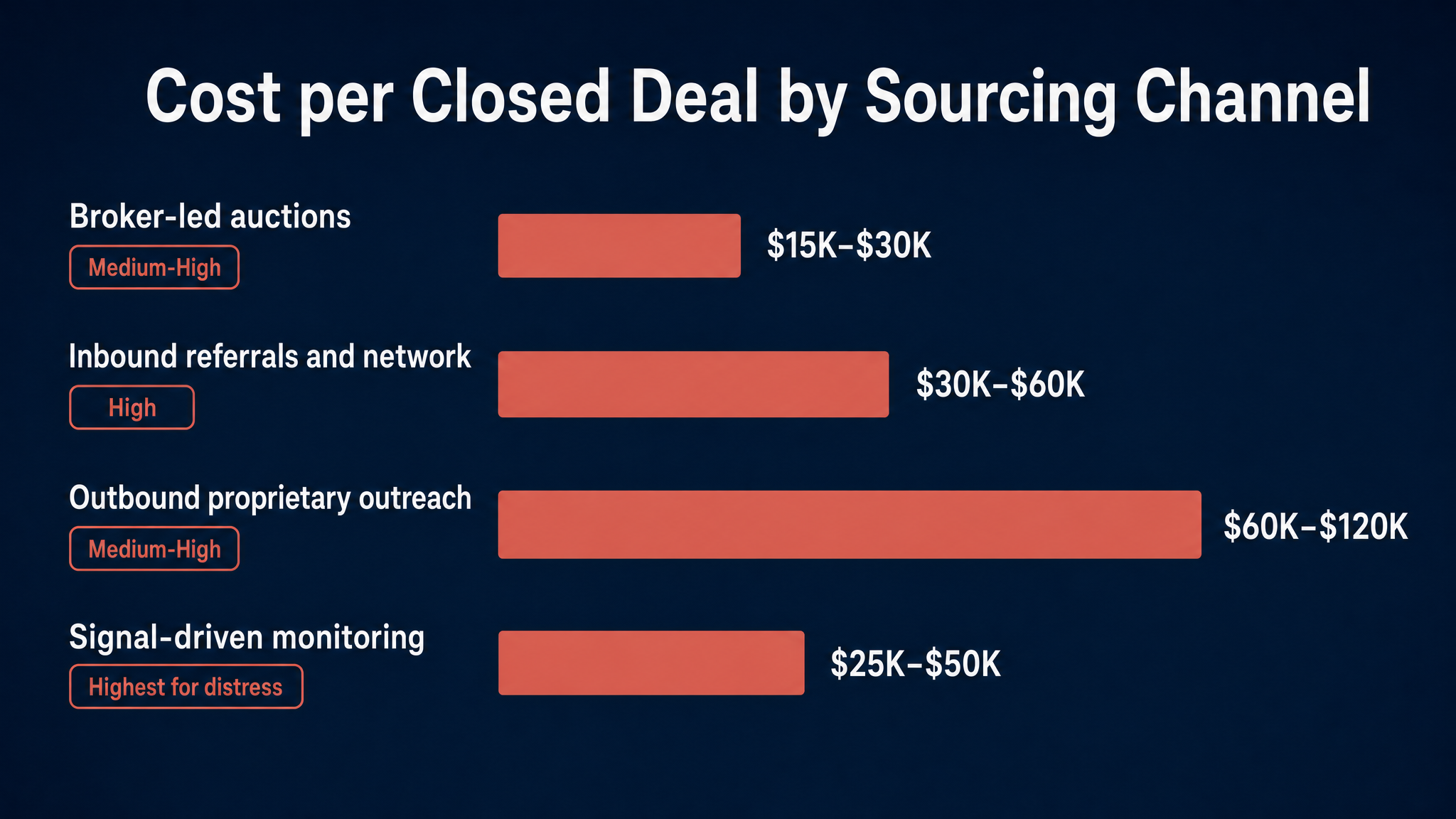
1. Broker-led auctions
The most expensive channel in real terms is the one that looks cheapest, because the cost is a success fee paid at close. On a competitive process, the buyer pays for the privilege of bidding against six other firms, often after the seller has already priced in what the process will bear.
Auctions are not irrational. They are efficient for clean, performing, well-documented businesses, and they are the fastest route to volume. The error is treating them as an origination strategy rather than a throughput channel. A firm that sources exclusively through auctions has outsourced its pipeline to whoever decides what reaches the market, and has no visibility of what never gets marketed at all.
Cost per closed deal: 0.5–1.5% of enterprise value in success fees, plus internal deal time.
Time to first deal: 3–6 months.
Fails when: the same process is visible to every competitor with the same broker list.
2. Inbound referrals and network
Referral flow is the highest-quality channel per transaction and the least predictable. It produces trust-based access, better pricing and cleaner diligence, because the recommendation carries information that no database does: the seller already knows you are a credible owner.
The cost is not a fee, it is maintenance: operating partners, advisers, lenders, former CEOs, portfolio company management, and the deliberate work of staying useful to all of them. That maintenance is easy to cut in a busy quarter and impossible to rebuild quickly.
Cost per closed deal: $25K–$100K in relationship development and coverage time.
Time to first deal: 6–18 months.
Fails when: the network is broad but shallow, and nobody in it would think of you first for a specific situation.
3. Outbound proprietary outreach
Direct, systematic outreach to owners and management teams outside a process. This is the channel most firms claim to run and few actually do at scale, because it is operationally heavy: research, qualification, personalised contact, follow-up discipline, and a long conversion cycle before anything closes.
It is also the channel where sequencing and volume discipline separate the professionals from the mass mailers. The quality of an outbound programme is a function of two things: how well the target list is qualified against a specific thesis, and whether the contact is timed to a moment when the owner or management team is genuinely receptive. A perfectly written message to an unprepared CEO is wasted effort; a mediocre message to a CFO who has just missed a covenant will get a reply.
Specialist outbound firms do this as their core service, building multi-channel sequences and structured follow-up around a defined target universe. Danish Lead Co makes the compounding case for this channel and works the lower mid-market end of it directly. The useful test of any such programme is not reply rate but whether it generates conversations that survive diligence, and whether the pipeline compounds from one quarter to the next rather than restarting each time.
Cost per closed deal: $50K–$200K in team, research and technology.
Time to first deal: 12–24 months.
Fails when: outreach is measured in contacts rather than conversations, and timing is ignored in favour of volume.
4. Signal-driven monitoring
The fourth channel does not start from a list. It starts from an event. Covenant pressure, a guidance cut, a sudden management departure, a divestiture announcement, a customer insolvency, a fund approaching its end of life: each of these creates a window in which a conversation is worth having and few competitors are having it.
Signal-driven sourcing has the highest quality profile for distressed and carve-out situations, because the signals arrive before a process exists. It is also the channel with the highest false-positive rate: for every genuine opportunity there are dozens of alerts that look identical and lead nowhere. Its economics depend entirely on the qualification layer, which is why monitoring without a thesis filter reliably produces exhaustion rather than deals.
Cost per closed deal: $30K–$120K in platform cost and one to two dedicated analysts.
Time to first deal: 6–12 months.
Fails when: the watchlist is too broad to action and no escalation thresholds are defined.
The Diligence Test: What Separates a Pipeline From a Fantasy
Every one of those four channels can produce a long list. Very few produce deals that close. The discipline that separates the two is applying a diligence test before investing in the origination effort, not after an LOI is signed.
For any surfaced opportunity, the test is a sequence of blunt questions:
- Does this target have a reason to transact in the next twelve months, or is this a signal without a seller?
- Is the business separable and operable on day one, or does it depend on a parent or a shared services arrangement that will take eighteen months to unwind?
- Are the financials clean enough to underwrite, or is the reported number a project rather than an input?
- Does the technology and operational dependency create a cost that the current valuation has not yet recognised?
- If this deal reached diligence tomorrow, what would stop it?
The last question is the one most firms cannot answer, and it is the one that determines whether an origination programme is compounding or merely busy. A pipeline where half the targets have an unresolved structural problem at the diligence stage is not half as good as a clean pipeline; it is a different asset with a different cost structure.
Why Outbound Sourcing Programmes Stall
Four failure patterns account for most of the wasted spend in proprietary origination.
1. Volume as the proxy for quality
Teams report emails sent and calls booked because those numbers are available weekly. Replies convert to meetings at a rate that looks acceptable in a dashboard and unacceptable in a partner meeting. The fix is to measure at the far end of the funnel: meetings that survive first review, and reviews that survive diligence.
2. Timing treated as an afterthought
The same message to the same CEO lands differently in a good year and a bad one. Systematic origination gets its edge from knowing when a business is ready to talk, not from saying something clever when the phone is answered. Every channel above should be evaluated on whether it produces timing information, not just contact information.
3. No qualification layer
Without a thesis filter, outbound and monitoring both degrade into a great deal of activity against a universe that was never viable. Narrowing the target set from tens of thousands of companies to a few hundred well-understood ones is the single highest-return decision in the whole system.
4. Execution capacity not underwritten
The final failure is structural: a firm generates a genuine proprietary opportunity and then discovers it cannot move fast enough. Distressed sellers want certainty of close, not the highest price, and a buyer who needs ninety days to understand what they are buying loses to one who needs thirty. Origination without execution capability produces conversations that end in silence.
Building the Engine in the Right Order
The order matters more than the sophistication of any single component.
First, define the thesis tightly enough to exclude things. A thesis that cannot reject a company is not a thesis. Sectors, size bands, situations, geography, and the specific structural characteristics that make a business interesting to you. This becomes the filter every channel feeds.
Second, build the qualification layer before the outreach layer. Enrichment, scoring and ownership mapping are cheaper than contact and far cheaper than a wasted diligence process. Firms that invert this order spend money on conversations they could have predicted would fail.
Third, run channels in parallel with different jobs. Auctions provide throughput and market pricing intelligence. Referrals provide access and trust. Outbound provides reach into a defined universe. Signals provide timing. Treating any single channel as the answer is what produces a fragile pipeline.
Fourth, make execution readiness explicit. Pre-committed capital, a diligence playbook that runs in weeks rather than months, and a technical assessment capability that can evaluate separation complexity and operational dependency before the LOI. This is the stage where most proprietary pipelines quietly leak.
Frequently Asked Questions
What is proprietary deal flow?
Proprietary deal flow is origination that reaches a target outside a competitive process: the seller is approached directly, or the opportunity is identified before it is marketed. It is defined by the absence of an intermediary-driven auction, not by the absence of advisers. The practical value is pricing and terms: fewer competing bidders and more room to structure around the seller’s real constraints.
How long does it take to build a proprietary deal flow engine?
Expect twelve to twenty-four months before the programme produces a consistent flow of qualified conversations, and longer before it produces a repeatable closing rate. Outreach and monitoring produce their first signals in six to twelve months, but the compounding effect that makes a pipeline proprietary in practice comes from consecutive quarters of disciplined execution against the same thesis.
Is outbound outreach worth it for private equity?
It depends entirely on qualification and timing. Outbound against a broadly defined universe produces low-quality conversations at high cost. Outbound against a narrow, well-understood target set, timed to moments of receptivity, is one of the few channels that reliably produces deals that never reach the open market. The channel is not the variable; the discipline behind it is.
How do you measure whether an origination programme is working?
By conversion at the far end of the funnel, not by activity at the front. The four numbers that matter are: qualified targets added per quarter, first conversations held, reviews that survive first-pass screening, and diligence processes that reach signing. A programme whose numbers look strong in the first two and weak in the last two is producing activity, not pipeline.
What is the most common mistake in proprietary sourcing?
Building the outreach layer before the qualification layer. It feels like progress because messages go out and replies come back, but it front-loads cost onto targets that a thesis filter would have excluded. The second most common mistake is treating origination as a volume problem when the constraint is usually execution capacity at the other end.
Where This Sits Alongside Distressed and Carve-Out Origination
The channels and failure patterns above are generic to proprietary origination. The specific mechanics change when the target is distressed or being carved out of a corporate parent, which the private equity carve-out guide covers in full: sellers rarely hire bankers, divisions do not appear in databases as standalone businesses, and the timing window is set by covenant and divestiture calendars rather than by management preference. Those mechanics are covered separately in our guide to sourcing off-market distressed and carve-out deals before auction, which covers the early-warning signal framework and the 30-day path from signal to LOI.
For the exit side of the same cycle, the private equity carve-out guide covers what separation readiness looks like when the seller is the one preparing a division for sale, and the technical due diligence report example shows the level of evidence a buyer should expect before committing to a carve-out with material technology dependency.
Where Proprietary Flow Ultimately Fails
A proprietary pipeline is only as valuable as the firm’s ability to act on it. The origination engine surfaces an opportunity months before the market; the diligence capability decides whether that head start converts into a signed deal or evaporates into a slow, uncertain process while a faster buyer closes.
That is where the technology and operational layer of diligence matters. Whether the target can be separated cleanly, whether its systems and dependencies will support the plan, and whether the costs below the reported number have been recognised: those questions determine the price a buyer can honestly pay, and they need answers before commitment rather than after closing.
The firms that compound proprietary deal flow are the ones who built this in the right order: a thesis that excludes, a qualification layer that filters, channels that each do a distinct job, and an execution capability that can underwrite what the pipeline produces. Everything else is marketing.