
Operational due diligence (ODD) has become the single most important driver of private equity returns — yet in distressed acquisitions, it’s where most deals go wrong. Since 2010, operational improvements have accounted for 47% of buyout value creation, up from just 18% in the 1980s, according to PwC. Meanwhile, financial engineering’s contribution has collapsed from over 50% to roughly 25%. The message is clear: you can’t spreadsheet your way to alpha anymore. But when the target is distressed — bleeding cash, shedding talent, running on deferred maintenance — traditional ODD frameworks break down. This guide shows you how to do operational due diligence that actually works when the clock is ticking, the data is incomplete, and the upside depends entirely on what you can fix.
Why Operational Due Diligence Matters More in Distressed Deals
In a healthy acquisition, operational due diligence is about validating assumptions and refining the value-creation plan. In a distressed deal, it’s about survival. The target may be losing customers, key employees may have one foot out the door, and the IT systems that run the business may be held together by institutional knowledge and prayer.
Consider the arithmetic. PwC’s research shows that operations now drive nearly half of all PE value creation. In a typical buyout, revenue growth contributes about 30%, multiple expansion about 23%, and margin improvement about 47% of total returns. In distressed situations, the margin component dominates — you’re not buying growth, you’re buying the gap between current performance and what competent operations could deliver.
But distressed targets present a paradox. The operational problems that make them cheap also make them hard to diligence. Financial statements may be unreliable. Management may be opaque or absent. Vendors may have already tightened payment terms. The very processes you need to assess are the ones malfunctioning. This is why a specialized operational due diligence approach — one that goes beyond the standard checklist — is not optional. It’s the difference between buying a turnaround and buying a liquidation.
According to Deloitte, technology integration issues alone account for approximately 30% of failed mergers. In distressed scenarios where the tech stack has suffered years of underinvestment, that number is almost certainly higher. EY’s 2025 guidance on operational due diligence emphasizes that investors must now assess supply chain resilience, tariff exposure, and digital maturity — factors that traditional financial due diligence never touches. The firms that win in distressed M&A are the ones that treat operational due diligence not as a compliance exercise but as the foundation of their entire investment thesis.
The Five Pillars of Operational Due Diligence

Every operational due diligence assessment should be structured around five interconnected pillars. In distressed situations, the weighting shifts — you spend less time on strategic alignment and more time on immediate survivability. But all five must be covered.
1. Management & Organizational Assessment
In a distressed company, management assessment is both more critical and more difficult. The team that led the company into distress may not be the team to lead it out. Key questions include: Who are the top 5-10 operational leaders below the C-suite, and are they staying? Is there a “key person” dependency — the one plant manager who knows how the production line actually works, the one IT director who understands the spaghetti-code ERP customizations? What is the flight risk given the stress environment? BCG research shows that distressed companies lose 15-25% of their top performers in the 12 months preceding a transaction, and the ones who remain are often the ones with the fewest options.
Look beyond the org chart. Interview shift supervisors, maintenance leads, and procurement managers. These are the people who know where the bodies are buried. Ask: “If you had $1 million to fix one thing, what would it be?” You’ll learn more in that conversation than from a hundred pages of management presentations.
2. Process Efficiency & Capacity Analysis
The core question: is this business operating at 40% of its potential, 70%, or 95%? The answer determines everything about your post-close plan. In manufacturing, assess overall equipment effectiveness (OEE), production line throughput variance, scrap rates, and changeover times. Compare against industry benchmarks. A plant running at 55% OEE when competitors average 75% has a massive operational upside — but you need to understand why it’s at 55%. Is it poor maintenance? Untrained operators? Broken supply chain? The fix is different in each case.
Capacity analysis must consider both current state and “surge” capability. If you’re acquiring a distressed manufacturer with plans to consolidate production from other facilities, can the target’s lines handle the additional volume? Have you factored in the capex for bottleneck equipment? We’ve seen deals where the capacity model assumed 85% utilization on paper, but the physical reality — 40-year-old presses with 60% downtime — made the consolidation thesis impossible without a seven-figure investment nobody had budgeted.
3. Technology & Systems Health
This is where most operational due diligence falls short — and where the biggest surprises hide. In distressed companies, IT is often the first budget cut and the last restored. The result: aging ERP systems with unsupported customizations, servers past end-of-life, cybersecurity practices that amount to “hope nobody attacks,” and a data architecture where critical business information lives in Excel files on departed employees’ desktops.
A technology assessment during ODD should cover at minimum: ERP version, support status, and customization burden; infrastructure age and cloud migration status; cybersecurity maturity (have they had a breach? when was the last penetration test?); IT staffing levels and key person risk; and the cost of “keeping the lights on” vs. the cost of modernization. According to Synoptek, IT operating costs jump 20-40% in the year following an acquisition — and that’s for healthy targets. In distressed situations, expect 50%+ as deferred maintenance comes due.
We explore technology assessment in depth later in this guide, but the headline is simple: if you don’t assess technology during ODD, you’re buying a liability, not an asset.
4. Supply Chain & Procurement Resilience
Distressed companies often lose negotiating power with suppliers. Payment terms tighten from net-60 to net-30 to COD. Credit insurance is withdrawn. Critical suppliers begin requiring prepayment or reduce allocation. EY’s 2025 operational due diligence framework identifies supply chain resilience as a top-three focus area, particularly given tariff volatility. For any target with global supply chains, map country-of-origin for Class A and B suppliers and model tariff scenarios. A supplier concentration where 80% of a critical component comes from one vendor in a tariff-exposed region is a value-at-risk number you need before closing.
Procurement assessment should cover: supplier concentration risk, contract status (are contracts current or has the distressed company stopped paying?), raw material cost trends, and the potential for quick-win renegotiation. In one manufacturing turnaround we analyzed, a distressed target was paying 22% above market for steel because their credit rating prevented them from shopping competitively. Post-acquisition, renegotiation saved $1.8 million in the first six months — entirely outside the financial model.
5. Cost Structure & Margin Sustainability
Distressed companies almost always have distorted cost structures. Some costs are inflated (panic spending, emergency freight, penalty rates). Others are artificially low (deferred maintenance, skeleton IT staff, suspended training programs). Your job during ODD is to normalize the cost base: what would this business cost to run if it were managed competently?
Build a “normalized EBITDA bridge” that accounts for: one-time distress costs you can eliminate (expedited shipping, consultant retainers, penalty interest); cost additions you’ll need to reinstate (maintenance, IT staffing, compliance programs); and structural cost advantages or disadvantages vs. competitors (labor rates, facility age, technology debt). This normalized view is your true starting point for the value-creation plan — and it often looks very different from the seller’s adjusted EBITDA presentation.
Why Operational Due Diligence Fails in Distressed Situations
Even experienced deal teams make predictable mistakes when operational due diligence meets distressed targets. These are the five failure patterns we see repeatedly — and how to avoid them.
Failure Pattern #1: Rushing Past the Tech Stack
In competitive distressed processes, speed is everything. Technology assessment gets compressed or skipped entirely because “we’ll fix IT post-close.” Six months later, the ERP crashes during month-end close, the backup was never tested, and the only person who knew the customizations left three weeks after closing. Cost of this failure: $500K-$3M+ in emergency remediation, plus operational disruption. Minimum viable technology assessment takes 3-5 days with the right framework. Skip it at your peril.
Failure Pattern #2: Trusting Stressed Management Projections
Management teams in distressed companies are under extraordinary pressure. They may genuinely believe their turnaround projections, or they may be telling you what you want to hear. Either way, their forecasts are unreliable. Cross-reference every projection against operational data: production volumes, machine utilization logs, actual headcount (not budgeted), real customer churn. If the operational data doesn’t support the financial projection, trust the operational data.
Failure Pattern #3: Ignoring Deferred Maintenance
When cash is tight, maintenance is the easiest budget to cut — and the most expensive to defer. Walk the factory floor. Look at maintenance logs. Ask when critical equipment was last overhauled. A manufacturing target with three-year-old maintenance backlogs isn’t a “high-margin opportunity” — it’s a ticking capital expenditure bomb. Rule of thumb: deferred maintenance in distressed industrials averages 3-5% of asset replacement value, and can run to 10%+ in severe cases.
Failure Pattern #4: Underestimating Vendor Relationship Damage
Distressed companies burn bridges. Suppliers who went unpaid for 120 days don’t forget. Key vendors who reduced allocation don’t automatically restore it when new ownership arrives. During ODD, call the top 10 suppliers directly. Ask about payment history, relationship quality, and whether they’d expand the relationship under new ownership. You may discover that the “strategic supplier partnership” described in the CIM is actually a vendor who’s one invoice away from cutting them off.
Failure Pattern #5: Skipping Cultural Assessment
Culture feels soft, but its consequences are hard. A distressed company may have developed a survival culture — everyone in bunker mode, hoarding information, blaming other departments, afraid to make decisions. That culture will eat your value-creation plan for breakfast. During ODD, assess: how are decisions made? Is there psychological safety to surface problems? What happened the last time someone proposed a change? The answers tell you whether you’re buying a team that can execute a turnaround or a team that needs to be rebuilt from scratch.
Technology Assessment: The Missing Layer in Most Operational Due Diligence
If there’s one area where traditional operational due diligence consistently underdelivers, it’s technology. Most ODD frameworks treat IT as a support function — check the box on “IT infrastructure exists” and move on. But in modern manufacturing and industrial businesses, technology is operations. The production line runs on PLCs and SCADA systems. Inventory management lives in the ERP. Customer orders flow through the CRM. A technology failure is an operational failure.
ERP Health Check: What a Fragile ERP Costs You
The ERP is the nervous system of any mid-market industrial business. In distressed targets, the ERP is typically: running an old version (or worse, an end-of-life version no longer supported by the vendor); heavily customized, often by a developer who left years ago; poorly integrated with shop-floor systems; and maintained by a single person or small team. A fragile ERP adds cost in multiple ways: manual workarounds consume 5-15% of administrative staff time; inaccurate inventory data drives overstock and stockouts; month-end close takes weeks instead of days; and audit risk increases as controls degrade.
During ODD, run a structured ERP assessment covering: version and vendor support status, customization inventory (how many custom objects/modules, who maintains them), integration map (what connects to what), data quality (duplicate records, completeness of key fields), and user satisfaction (survey a sample of operational users, not just IT). An ERP migration or major upgrade in a distressed manufacturing company typically costs $500K-$2M and takes 12-18 months. Know that number before you close.
Automation Potential: Where Machines Beat Margins
Manufacturing automation is the single largest operational EBITDA lever available to PE investors — and it’s systematically under-assessed during due diligence. The opportunities fall into three tiers: Tier 1: Process automation (robotic process automation for back-office tasks like AP/AR, order entry, inventory reconciliation — 20-40% cost reduction, 6-12 month payback). Tier 2: Production automation (CNC retrofits, automated material handling, quality inspection systems — 15-30% labor reduction, 12-24 month payback). Tier 3: End-to-end digital operations (IoT sensors for predictive maintenance, digital twin for production optimization, AI-driven scheduling — 10-25% throughput improvement, 18-36 month payback).
According to research from Withum, sector-specialized PE firms that deploy AI and automation across similar portfolio companies can achieve 3-5% EBITDA improvement from back-office automation alone, and 8-15% when production-floor automation is included. Generalist firms without sector concentration typically capture only 1-2% from back-office automation because they can’t amortize the investment across multiple similar businesses.
IT Cost Baseline: The 15-30% Optimization Opportunity
Distressed companies almost universally overspend on IT relative to the value they receive. Common patterns: paying for unused software licenses (the classic “we bought 500 seats, we have 312 employees”), running on-premise servers at 15% utilization, maintaining legacy systems that duplicate functionality, and paying premium support contracts on outdated versions. A focused IT cost optimization can typically reduce IT spend by 15-30% within 6-12 months without degrading operations — and in many cases, improving them through consolidation and modernization.
During ODD, request: software license inventory with actual usage data, IT vendor contracts (look for auto-renewal clauses and termination penalties), infrastructure asset list with age and utilization, and IT spend as a percentage of revenue benchmarked against industry peers. A target spending 4.2% of revenue on IT when peers average 2.8% isn’t more sophisticated — it’s more wasteful.
Cybersecurity Posture: The Deal-Breaker No One Checks
Distressed companies are soft targets for cyber attacks. Underinvested defenses, distracted management, and high turnover create the perfect conditions for a breach. And a breach post-close can destroy your investment thesis overnight. According to IBM’s Cost of a Data Breach report, the average breach costs $4.45 million — and that’s for companies that had security programs. During ODD, at minimum: check when the last penetration test was performed (if never, that’s a red flag), verify whether they’ve had a breach in the last 24 months (and what was done about it), assess whether they have cyber insurance (and if so, what it covers), and review basic hygiene (multi-factor authentication, patch management, backup testing).
In manufacturing specifically, assess the OT (operational technology) environment separately from IT. Production systems often run on Windows XP or similarly obsolete platforms because “the line works, don’t touch it.” These systems are unpatched, unmonitored, and connected to the corporate network — a direct path from a phishing email to a production shutdown.
The ODD-Value Creation Bridge: From Findings to EBITDA
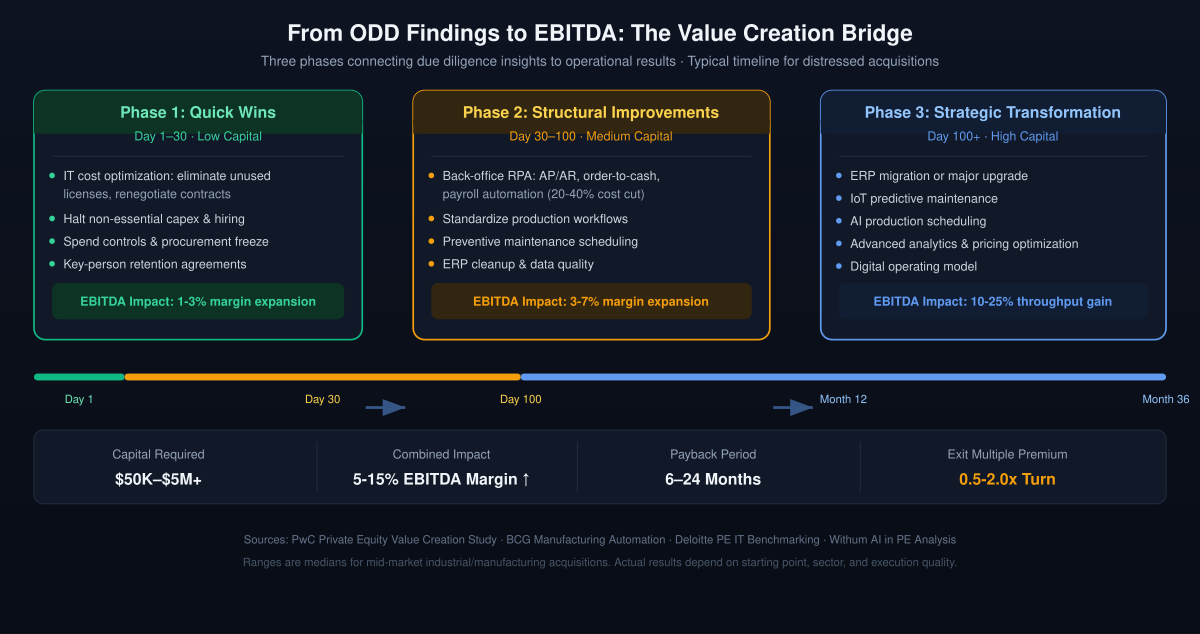
The best operational due diligence in the world is worthless if it doesn’t translate into action. Every finding should connect to a specific post-close initiative with a timeline, owner, and quantified EBITDA target. Here is how to structure the bridge from assessment to execution.
Quick Wins (Day 1-30): IT Cost Rationalization
Start with the low-hanging fruit that builds momentum and funds the rest of the plan. IT cost optimization is the fastest path to measurable savings: eliminate unused software licenses, renegotiate vendor contracts under new ownership, consolidate redundant systems, and move non-critical workloads to cheaper infrastructure. These actions typically free up 1-3% of revenue in the first quarter — cash that funds the next phase. Other Day-1 wins: halt non-essential capex, freeze hiring except for critical operations roles, and implement basic spend controls if they don’t exist.
Structural Improvements (Day 30-100): Process Automation
Once the bleeding stops, shift to structural improvements that change the cost curve permanently. Deploy RPA for high-volume back-office processes (AP, AR, payroll, order-to-cash). Standardize production workflows across shifts (you’d be surprised how often the night shift runs differently from the day shift). Implement basic preventive maintenance scheduling if it doesn’t exist. Begin ERP cleanup and data quality initiatives. These improvements typically deliver 3-7% margin expansion over 6-12 months.
Strategic Transformation (Day 100+): Digital Operating Model
The long game: modernize the technology foundation to create a genuinely digital operating model. This may involve ERP migration, IoT deployment for predictive maintenance, advanced analytics for pricing and demand forecasting, and AI-driven production scheduling. These programs are capital-intensive ($1-5M+) and take 18-36 months, but they can deliver 10-25% throughput improvement and position the business for a premium exit multiple.
EBITDA Impact Benchmarks by Lever
| Operational Lever | Typical EBITDA Impact | Timeline | Capital Required |
|---|---|---|---|
| IT cost optimization | 1-3% margin expansion | Day 1-30 | Low ($50-150K) |
| Back-office automation (RPA) | 1-2% margin expansion | Day 30-100 | Medium ($150-500K) |
| Procurement renegotiation | 2-4% COGS reduction | Day 30-100 | Low ($0-100K) |
| Production automation | 3-8% margin expansion | Day 100-365 | High ($500K-3M+) |
| ERP modernization | 2-5% margin expansion | 12-24 months | High ($500K-2M+) |
| IoT / predictive maintenance | 5-15% downtime reduction | 12-18 months | Medium ($200-800K) |
| Digital operating model | 10-25% throughput improvement | 18-36 months | High ($1-5M+) |
Sources: PwC Private Equity Value Creation study, BCG Manufacturing Automation Benchmarking, Deloitte IT Cost Optimization for PE Portfolio Companies, Withum AI in PE analysis. Ranges are industry medians; actual results depend on starting point, sector, and execution quality.
Operational Due Diligence Checklist for Distressed Acquisitions
Use this checklist as your minimum viable operational due diligence framework. Adapt it to your sector, deal size, and timeline, but don’t skip any section.
Pre-LOI (Indicative Assessment — 3-5 Days)
- Interview the CEO, COO, and head of operations (if separate roles exist). Ask: “What broke and when?”
- Review last 12 months of production/MES data: volumes, yields, downtime, scrap rates
- Request org chart with tenure and flight risk assessment for top 20 operational leaders
- Obtain ERP version, vendor, support status, and customization inventory
- Request IT spend breakdown: licenses, infrastructure, headcount, contractors
- Review top 10 supplier contracts and payment status — any on stop-credit or COD?
- Walk the floor (if manufacturing) or shadow operations (if services) for at least half a day
- Check: when was the last cybersecurity assessment or penetration test?
- Identify 3-5 “quick win” EBITDA opportunities and size them roughly
- Flag any operational deal-breakers: unsupported ERP, critical equipment beyond economic repair, key person departure risk above 50%
Confirmatory Diligence (Post-LOI — 10-15 Days)
- Deep-dive on production data: validate volumes, yields, OEE against industry benchmarks
- Technology assessment: infrastructure audit, cybersecurity penetration test, ERP integration map
- Supplier interviews: call top 10 suppliers, assess relationship health and credit status
- Customer interviews: top 10 customers, churn risk, service-level performance
- Management assessment: structured interviews with top 10-20 operational leaders, retention risk analysis
- Cost normalization: build the “normalized EBITDA bridge” with distress adjustments
- Automation opportunity sizing: process mapping for top 5 back-office and top 5 production processes
- Deferred maintenance quantification: equipment-by-equipment assessment with cost estimates
- Regulatory/compliance check: environmental permits, safety records, union agreements
- Synthesize into a Day-1-to-100 operational plan with owners, timelines, and quantified targets
Red Flag Triage Framework
When you find red flags (and you will), triage them into three categories:
- Deal-breakers (walk away): Unsupported ERP with no migration path under $2M, systemic fraud or regulatory violations, critical equipment beyond repair with no alternative supply, entire management team departure risk
- Price adjusters (negotiate): Deferred maintenance above 5% of asset value, IT investment requirement above $500K, supplier relationships requiring cash prepayments to restore, customer concentration above 50% with churn risk
- Plan inputs (factor into 100-day plan): Normal cost optimization opportunities, automation potential, process standardization needs, cultural improvement program
How AssetMax Strengthens Your Operational Due Diligence
Operational due diligence for distressed acquisitions demands specialized tools — you can’t assess technology, operations, and risk with spreadsheets alone. AssetMax’s product suite is purpose-built for investors who need to move fast without missing what matters.
Diligize accelerates technology assessment during ODD. It analyzes the target’s IT landscape — ERP health, cybersecurity posture, infrastructure age, automation readiness — and produces a quantified risk-and-opportunity report in days, not weeks. For distressed deals where IT assessment is often skipped entirely, Diligize ensures you don’t buy a technology time bomb.
CarveX is essential when the distressed target is being carved out of a larger corporate parent — a common pattern in special situations. CarveX maps the operational separation requirements, TSA dependencies, and standalone cost structure, so you know exactly what you’re buying and what you’ll need to stand up post-close.
Copernicus provides post-close operational monitoring, tracking the KPIs you identified during ODD and alerting you when performance deviates from the value-creation plan. It closes the loop between due diligence findings and actual execution, ensuring the operational upside you underwrote becomes operational reality.
Frequently Asked Questions
What is operational due diligence in private equity?
Operational due diligence (ODD) is the systematic evaluation of a target company’s operational capabilities, processes, systems, and people to identify risks, validate value-creation opportunities, and develop a post-acquisition improvement plan. Unlike financial due diligence — which examines historical performance — ODD assesses whether the business can actually deliver the projected returns given its operational reality.
How is operational due diligence different in distressed acquisitions?
In distressed deals, ODD must be faster, more focused on survivability, and more skeptical of management-provided data. Key differences include: heavier weighting on technology assessment (deferred IT maintenance is common), direct supplier interviews (vendor relationships are often damaged), explicit deferred maintenance quantification, and a sharper focus on “what breaks in the first 100 days” vs. long-term strategic optimization.
What are the key components of an operational due diligence checklist?
A comprehensive ODD checklist covers five pillars: (1) management and organizational assessment, (2) process efficiency and capacity analysis, (3) technology and systems health, (4) supply chain and procurement resilience, and (5) cost structure and margin sustainability. In distressed situations, add: deferred maintenance quantification, vendor relationship assessment, and key-person flight risk analysis.
Why is technology assessment important in operational due diligence?
Technology underpins every operational process in a modern business. A failing ERP disrupts production, inventory, and financial reporting. Cybersecurity weaknesses can destroy value post-close. Deferred IT maintenance creates hidden liabilities. According to Deloitte, technology integration issues account for 30% of failed mergers — and the risk is higher in distressed targets where IT has been underfunded for years.
How much does operational due diligence typically cost?
Traditional ODD consulting engagements range from $50K-$250K depending on deal size and complexity. Technology-focused ODD tools like Diligize can reduce this cost by 40-60% while accelerating turnaround from weeks to days. The real cost of inadequate ODD, however, is measured in failed investments — technology integration failures alone cost $500K-$3M+ per incident.
What EBITDA improvements can operational due diligence uncover?
Typical operational improvement opportunities identified during ODD include: IT cost optimization (1-3% margin expansion), procurement savings (2-4% COGS reduction), back-office automation (1-2% margin expansion), production automation (3-8% margin expansion), and digital transformation (10-25% throughput improvement). Combined, a well-executed operational improvement program can deliver 5-15% EBITDA margin expansion over 12-24 months.
How long does operational due diligence take?
A thorough ODD process takes 2-4 weeks for a mid-market acquisition. Pre-LOI indicative assessment can be completed in 3-5 days. Confirmatory diligence post-LOI typically requires 10-15 days. In competitive distressed processes, the timeline compresses significantly — making it critical to have a structured framework and the right technology tools to accelerate assessment without sacrificing depth.
What are the most common red flags in operational due diligence?
The most dangerous red flags in ODD include: unsupported or heavily customized ERP systems with no migration path, deferred maintenance exceeding 5% of asset replacement value, key person dependencies in critical operational roles, supplier relationships on COD or stop-credit, cybersecurity posture with no recent penetration testing, and material gaps between management projections and operational data. Any one of these can derail a deal; multiple red flags in combination often signal a fundamentally broken operation.
Who should conduct operational due diligence?
ODD is typically led by the PE firm’s operating partners, supported by external consultants for specialized areas (IT, supply chain, manufacturing). Increasingly, firms are using technology platforms to accelerate the assessment and provide quantitative baselines. The ideal ODD team combines sector expertise, operational turnaround experience, and technology fluency — pure financial analysts without operational backgrounds miss critical signals.
How does operational due diligence connect to post-acquisition value creation?
ODD is the foundation of the value-creation plan. Every finding should map to a specific post-close initiative with a timeline, owner, and quantified EBITDA target. The bridge from ODD to execution has three phases: Quick Wins (Day 1-30, IT cost optimization and spend controls), Structural Improvements (Day 30-100, process automation and procurement renegotiation), and Strategic Transformation (Day 100+, digital operating model). Without this structured bridge, ODD findings become shelfware.
Published July 2026. This article is for informational purposes and does not constitute investment, legal, or professional advice. Operational due diligence requirements vary by sector, deal structure, and jurisdiction. Consult qualified advisors for transaction-specific guidance.