
Most distressed assets and carve-out opportunities are won or lost before they ever reach an auction. The investors who consistently find these deals aren’t the ones with the biggest teams or the deepest broker networks. They’re the ones who’ve built systematic, signal-driven origination engines that surface opportunities months before anyone else sees them.
According to McKinsey, the gap between the best-connected buyers and the rest of the market is widening: proprietary deal flow now accounts for roughly 40% of all PE acquisitions in the middle market. In distressed and special situations, the advantage is even starker. The most attractive carve-outs often change hands through bilateral negotiations that never see a data room.
This guide is for investors who want to move beyond broker-led auctions and build a repeatable system for finding off-market distressed and carve-out deals. We’ll cover the full sourcing framework: the early-warning signals that surface targets, the channels that produce the highest-quality flow, the technology stack that scales origination, and the real cost economics of each approach.
Why Traditional Deal Sourcing Fails for Distressed and Carve-Out Deals
Most PE firms and family offices rely on three sourcing channels: broker-led auctions, self-serve databases (PitchBook, Capital IQ, Grata), and inbound referrals. These work moderately well for standard platform acquisitions in healthy sectors. They fail systematically for distressed situations and carve-outs, for three structural reasons.
1. Distressed sellers don’t hire bankers
A company facing covenant pressure, liquidity constraints, or an imminent default rarely has the luxury — or the budget — to run a formal M&A process. By the time a CIM exists and a sell-side banker has been retained, the opportunity is already widely marketed. The pricing advantage of buying distress has been competed away.
The best distressed deals happen when a lender pushes for a sale, when a management team recognises the business needs a better-capitalised owner, or when a corporate parent quietly decides a division no longer fits. None of these scenarios start with a beauty parade of buyers.
Corporate carve-outs don’t appear in standard databases as standalone targets because they aren’t standalone businesses yet. They’re divisions, business units, or product lines embedded inside larger organisations — sharing ERP systems, HR platforms, supply chains, and balance sheets. The parent may not even have decided to sell. The deal opportunity only crystallises when an investor identifies the strategic misalignment and approaches proactively.
According to Bain & Company, corporate divestitures reached a 20-year high in 2024–2025, driven by portfolio simplification, regulatory pressure, and post-pandemic strategic realignment. The firms winning these deals are the ones who identify the opportunity 6–12 months before a formal process begins.
3. Databases are backward-looking
PitchBook and Capital IQ are excellent for researching companies you already know about. They are poor at surfacing companies whose financial stress hasn’t yet appeared in public filings, or whose distress is operational rather than financial. A company can be haemorrhaging market share, losing its largest customer, or experiencing a supply chain crisis — and still show clean financials for 12–18 months after the problems start.
By the time the distress shows up in trailing-twelve-month EBITDA, it’s already widely visible. The sourcing advantage belongs to firms that detect distress before it hits the financial statements.
The Signal-Led Sourcing Framework: 8 Early-Warning Indicators
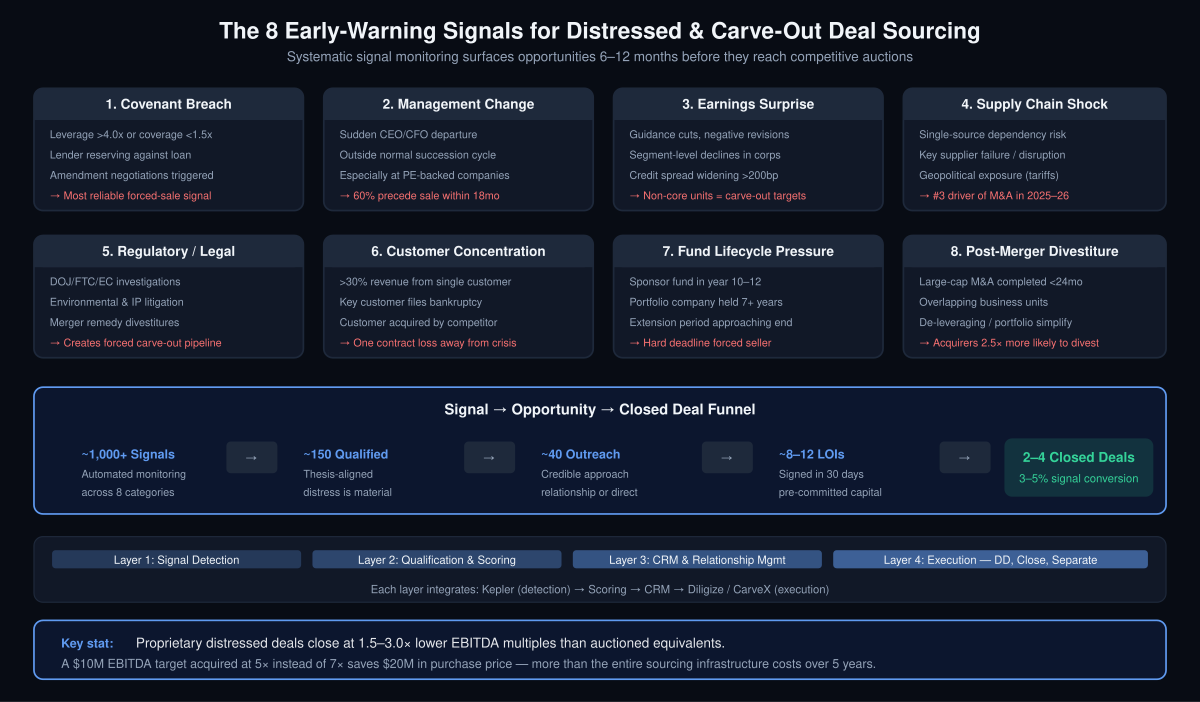
Top-performing special situations investors don’t wait for deals to come to them. They build monitoring systems that surface targets based on specific distress and dislocation signals. The following eight indicators form a systematic framework for proactive origination — and they’re the signals that Kepler, AssetMax’s deal monitoring platform, is designed to track at scale.
1. Covenant Breaches and Tightening Headroom
Covenant breaches are the single most reliable leading indicator of a forced sale. When a leveraged company trips a leverage or interest coverage covenant, it enters a negotiation with its lenders. Those negotiations often conclude with the lenders demanding a sale process — and those processes move fast.
Monitor debt agreements through credit rating agency reports, lender presentations, and private credit fund disclosures. Key triggers: leverage ratio exceeding 4.0x, interest coverage falling below 1.5x, or a lender reserving against the loan. According to Moody’s, covenant-lite issuance has declined since 2023, meaning more mid-market companies now operate with maintenance covenants that can trigger — and signal — distress early.
2. Management Turnover in PE-Backed Companies
When a PE-backed company replaces its CEO or CFO outside the normal succession cycle, it’s often the first public signal of underperformance. The sponsor has lost confidence in the management team’s ability to hit plan — and a new executive team is brought in to stabilise or restructure. In many cases, the next step is a sale.
Track C-suite changes at PE portfolio companies systematically. LinkedIn alerts, executive search firm announcements, and trade publication moves sections are the best sources. A study by AlixPartners found that sudden CEO departures at sponsor-backed businesses preceded a sale or recapitalisation within 18 months in over 60% of cases.
3. Negative Earnings Surprises and Guidance Cuts
Public companies and credit-rated private companies report quarterly. A meaningful guidance cut — particularly one driven by structural rather than cyclical factors — creates immediate selling pressure. The stock drops, the credit spreads widen, and the board starts asking whether the business would be better served by a strategic acquirer.
For carve-outs specifically, watch for large-cap companies reporting segment-level declines in non-core divisions. A division that’s shrinking while the parent is growing is a divestiture candidate. These segments often aren’t tracked by sell-side analysts as standalone opportunities.
4. Supply Chain Disruption Exposure
Companies with concentrated supplier bases, single-source dependencies, or exposure to geopolitically sensitive regions are structurally vulnerable. When a key supplier fails, the company’s survival may depend on a rapid sale to a buyer who can provide the supply chain stability or working capital injection it needs.
McKinsey’s 2025 M&A Annual Report highlighted supply chain resilience as one of the top three drivers of M&A activity globally, with direct investment and acquisition becoming the preferred tools for de-risking supply chains. Monitor supplier concentration disclosures, import/export data, and trade restriction announcements for early signals.
5. Regulatory and Legal Triggers
Regulatory investigations, environmental litigation, IP disputes, and antitrust actions create both distress and divestiture pressure. A company facing a DOJ investigation may need to sell non-core assets to fund legal costs. A merger blocked by competition authorities may require a carve-out remedy.
Systematically monitor regulatory filings, court dockets, and agency announcements. The Department of Justice, FTC, European Commission, and sector-specific regulators (FDA, EPA, FCA) all publish enforcement actions that signal deal opportunities.
6. Customer Concentration Risk
A company that derives more than 30% of revenue from a single customer is one contract loss away from a liquidity crisis. When that customer files for bankruptcy, announces a supplier change, or is acquired by a competitor, the supplier faces an existential threat — and an acquisition becomes a real possibility.
Monitor customer disclosures in public filings, news about major contract wins and losses, and industry consolidation that could threaten dependent suppliers.
7. Sponsor Fund Lifecycle Pressure
PE funds have finite lives — typically 10 years with two one-year extensions. When a fund approaches year 12 without having exited a portfolio company, the sponsor faces a hard deadline. The asset must be sold, regardless of market conditions. These “fund-lifecycle distressed” sales often happen at a meaningful discount to intrinsic value.
Track fund vintages and portfolio company holding periods. A company that has been held for 7+ years in a fund that’s in year 10+ is a forced seller. Data from Preqin and PitchBook can help map these pressured situations.
8. Post-Merger Divestiture Signals
When a large company completes a major acquisition, non-core divisions of the combined entity frequently come up for sale within 12–24 months. The acquirer needs to de-lever, simplify the portfolio, or shed businesses that don’t fit the strategic thesis.
Monitor large-cap M&A announcements and then map the combined entity’s business units. The overlap, the non-core units, and the regulatory remedy assets are your carve-out pipeline. Bain’s research shows that companies that actively acquire are 2.5× more likely to also divest in the following 24 months.
The Four Sourcing Channels: Cost, Quality, and Timeline Benchmarks
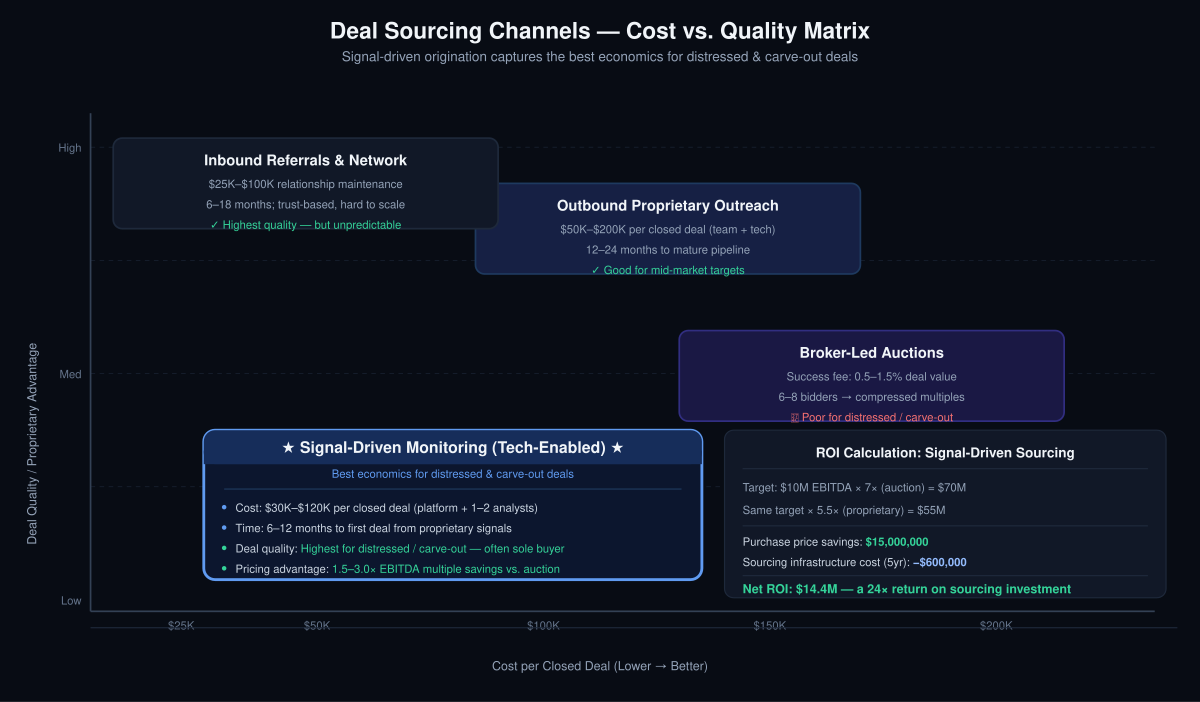
Every deal sourcing channel has a different cost structure, quality profile, and time horizon. The most successful special situations investors deploy a multi-channel strategy, allocating capital and effort based on the return profile of each channel.
| Sourcing Channel | Est. Cost per Closed Deal | Typical Deal Quality | Time to First Deal | Best For |
|---|---|---|---|---|
| Broker-led auctions | 0.5–1.5% of deal value (success fee) | Medium–High | 3–6 months | Standard platform acquisitions |
| Inbound referrals & network | $25K–$100K (relationship maintenance) | High | 6–18 months | Proprietary, trust-based deals |
| Outbound proprietary outreach | $50K–$200K per closed deal (team + tech) | Medium–High | 12–24 months | Off-market mid-market targets |
| Signal-driven monitoring (tech-enabled) | $30K–$120K (platform + 1–2 analysts) | Highest for distressed | 6–12 months | Distressed & carve-out opportunities |
The economics shift dramatically when you move from generic deal sourcing to signal-driven origination. A broker-led auction for a healthy company might yield a competitive process with 6–8 bidders. A signal-driven approach to a distressed carve-out might mean you’re the only serious buyer at the table. The multiple difference — often 2–3 turns of EBITDA — more than covers the technology investment.
Building the Technology Stack for Signal-Driven Origination
The technology to systematically monitor distress signals exists today — and it’s no longer the exclusive domain of multi-billion-dollar funds. A well-architected origination tech stack has four layers:
Layer 1: Data Aggregation and Signal Detection
This layer ingests data from financial databases, news sources, regulatory filings, legal dockets, social media, and credit rating platforms. It detects anomalies and patterns — a covenant breach, a guidance cut, a management departure — and flags them as potential deal signals.
For investors targeting distressed and carve-out deals, this is where Copernicus, AssetMax’s competitive intelligence platform, provides a distinct advantage. By monitoring thousands of companies across multiple signal categories simultaneously, Copernicus surfaces opportunities that individual analysts would miss — the mid-market manufacturer whose largest customer just filed for bankruptcy, the division of a Fortune 500 that’s been flagged for divestiture in strategy documents, the sponsor-backed company whose CEO just resigned unexpectedly.
Layer 2: Target Qualification and Scoring
Raw signals produce noise. The second layer applies filters: is this distress signal material enough to create a deal opportunity? Does the company fit our investment thesis? Is the cap structure conducive to a transaction?
Platforms like Grata, SourceScrub, and Kepler enable systematic qualification — scoring targets against custom criteria, enriching company profiles with financial and ownership data, and prioritising the highest-conviction opportunities for outreach.
Layer 3: Relationship Management and Outreach
Signals are useless without a relationship layer. The third layer is a CRM purpose-built for deal origination — tracking every interaction with founders, CEOs, intermediaries, and operating partners. Affinity, DealCloud, and Salesforce-based solutions dominate this category.
For distressed and carve-out situations, the outreach playbook is different from standard private equity. You’re not just building relationships — you’re timing them to moments of maximum receptivity. The CFO who just missed a covenant is far more open to a conversation than the CFO who’s comfortably within headroom.
Layer 4: Execution Readiness
The fourth layer ensures you can move fast when a signal converts to an opportunity. Distressed deals have compressed timelines — sellers want certainty of close, not the highest possible price.
This means having pre-committed capital, a due diligence playbook that can execute in weeks rather than months, and technical assessment capabilities that can evaluate IT separation complexity, operational entanglement, and cyber risk before an LOI is signed. Platforms like Diligize and CarveX accelerate technical due diligence and carve-out planning, allowing investors to move from signal to signed LOI in 30–45 days instead of the industry-standard 90–120.
Why Deal Sourcing Technology Fails: The Five Most Common Mistakes
Investing in technology without fixing process is the fastest way to burn capital on deal sourcing. We’ve observed five recurring failure patterns across dozens of special situations funds and PE firms:
Mistake 1: Monitoring Too Many Companies
A platform that monitors 100,000 companies produces 100,000 alerts. Without a tight thesis filter, the team drowns in noise. The most effective firms monitor 500–2,000 target companies deeply, across multiple signal categories, with clear escalation thresholds. A smaller, higher-conviction watchlist produces higher-quality deal flow than a broad, shallow net.
Mistake 2: Treating Platform Spend as a Substitute for Relationship Building
Technology can tell you that a company is in distress. It cannot tell the founder that you’re the right buyer. The signal identifies the opportunity; the relationship wins it. Funds that invest heavily in monitoring platforms but underinvest in sector-specialist deal partners consistently underperform firms with the opposite allocation.
Mistake 3: Ignoring the Operational Signals
Most monitoring focuses on financial data — leverage, liquidity, profitability. But operational distress often precedes financial distress by 6–18 months. A company losing its largest customer, facing a product recall, suffering a cyber breach, or experiencing factory downtime may look fine on a trailing-twelve-month income statement while the business is quietly collapsing.
Monitoring operational signals — customer churn, supplier disruptions, regulatory actions, IT incidents — requires different data sources and a different analytical lens. It’s harder to automate, but it’s where the alpha lives.
Mistake 4: Failing to Integrate Sourcing and Due Diligence
When a signal converts and an LOI is signed, the due diligence clock starts. In distressed situations, that clock runs fast. If the sourcing team and the diligence team operate on different platforms, in different cadences, with different assumptions, deals fall apart. The technology stack needs to connect the signal to the close — from initial detection through technical assessment, financial modelling, and legal documentation.
Mistake 5: No Feedback Loop
The highest-performing origination engines learn. They track which signals produced the highest conversion rates to LOIs — and which produced false positives. They refine the monitoring criteria, the scoring algorithms, and the outreach playbooks based on real data. Funds that don’t close the feedback loop between sourcing and outcomes are essentially guessing, quarter after quarter.
The Special Situations Sourcing Calendar: When to Monitor What
Not all distress signals are available year-round. A systematic sourcing programme aligns monitoring activity with the calendar of financial reporting, regulatory cycles, and seasonal business patterns.
| Period | Key Signals to Monitor | Why |
|---|---|---|
| January–February | Year-end covenant testing, annual audit qualifications, Q4 earnings | Year-end financials trigger covenant tests; going concern opinions appear in annual reports |
| March–April | Q1 earnings, supplier contract renewals, tariff adjustments | First quarter sets the tone for annual guidance; customer and supplier renegotiations surface |
| May–June | Fund lifecycle events, mid-year strategy reviews, activist campaigns | Sponsors nearing fund end evaluate exits; corporate strategy reviews trigger divestiture decisions |
| July–August | H1 results, summer liquidity crunches, trade show intelligence | Mid-year results expose underperformers; seasonal cash flow stress hits cyclical businesses |
| September–October | Q3 earnings, budget planning, regulatory year-end actions | Budget cycles trigger non-core divestiture decisions; regulatory agencies close cases before year-end |
| November–December | Year-end distressed sales, tax-loss selling, FY covenant negotiations | Lenders and sponsors push to resolve distressed situations before year-end reporting |
From Signal to Signed LOI: The 30-Day Execution Timeline
In distressed and carve-out situations, speed is the single largest competitive advantage. A well-prepared investor can move from signal detection to a signed LOI in 30 days — but only if the execution infrastructure is in place before the signal fires.
- Days 1–3: Signal verification. Confirm the distress signal through multiple sources. Review the company’s capital structure, ownership, and recent performance. Assess whether the distress is cyclical (recoverable) or structural (requires new ownership).
- Days 4–7: Technical pre-diligence. Using platforms like Diligize, run a rapid technology and operations assessment. What systems does the business run on? What’s the IT separation complexity for a carve-out? Are there cybersecurity red flags that could kill the deal?
- Days 8–14: Financial modelling and investment committee prep. Build the investment thesis, model the returns under multiple scenarios, and prepare the IC memo. Have financing conversations in parallel — distressed sellers care about certainty of funds above all else.
- Days 15–21: First approach. Make contact through the most credible channel — an existing relationship, a trusted intermediary, or (for corporate carve-outs) direct outreach to the parent’s corporate development team. The conversation should be specific: you understand their situation, you’ve done the work, and you can close quickly.
- Days 22–30: LOI negotiation and signing. Move to a non-binding LOI with a short exclusivity period. The LOI should demonstrate seriousness — committed financing, a diligence plan with clear milestones, and a realistic closing timeline.
This timeline sounds aggressive, and it is. But it’s what the best special situations investors achieve routinely. The key is preparation: the monitoring infrastructure, the diligence capability, and the capital commitment must all be in place before the signal fires.
Measuring What Matters: Sourcing KPIs for Special Situations
Most firms measure deal sourcing by volume: number of deals reviewed, number of NDAs signed, number of LOIs issued. For distressed and carve-out origination, these metrics are misleading. A high-volume, low-quality pipeline costs more in wasted diligence time than it generates in closed deals.
Shift to quality-weighted metrics:
| Metric | What It Tells You | Benchmark (Top Quartile) |
|---|---|---|
| Signal-to-LOI conversion rate | Quality of signal detection and qualification | 3–5% of qualified signals → LOI |
| LOI-to-close conversion rate | Execution capability and diligence quality | 60–75% of signed LOIs → close |
| Average time from signal to LOI | Speed of origination engine | 30–60 days |
| Proprietary deal share | Effectiveness of off-market sourcing | >50% of closed deals were off-market |
| Sourcing cost per closed deal | Efficiency of origination spend | <2% of deployed capital |
| EBITDA multiple advantage vs. auction | Pricing benefit of proprietary sourcing | 1.5–3.0× lower than auction comps |
Frequently Asked Questions
What is off-market deal origination in private equity?
Off-market deal origination is the proactive sourcing of acquisition targets that are not being formally marketed through investment banks or brokers. It involves identifying companies through data signals, direct outreach, and relationship networks before a competitive auction process begins. For distressed and carve-out deals, off-market origination is especially valuable because distressed sellers often bypass formal processes entirely, creating opportunities for buyers to negotiate bilateral deals at lower multiples with less competition.
What are the best early warning signals for identifying distressed companies?
The most reliable early warning signals for distressed companies include: covenant breaches or tightening loan headroom, sudden C-suite departures (especially at PE-backed companies), negative earnings surprises and guidance cuts, supply chain disruptions exposing single-source dependencies, regulatory investigations, customer concentration risk exceeding 30% of revenue, PE fund lifecycle pressure (assets held 7+ years in funds approaching year 12), and post-merger divestiture announcements from large acquirers.
How much does a deal sourcing technology platform cost?
Deal sourcing platform costs range from $5,000–$15,000 per seat per year for data aggregation tools (Grata, SourceScrub), to $25,000–$100,000+ for enterprise-grade monitoring platforms with AI-driven signal detection. The total technology investment for a mid-market fund running a systematic signal-driven origination programme typically falls between $30,000 and $120,000 per closed deal when including platform costs, data subscriptions, and 1–2 dedicated analysts. This investment is recovered through more favourable purchase multiples — a 1.5× EBITDA advantage on a $10M EBITDA target saves $15M in purchase price.
What’s the difference between proprietary and intermediated deal flow?
Proprietary deal flow comes from direct sourcing — the investor identifies, approaches, and negotiates with the target without intermediaries. Intermediated deal flow comes through investment banks, brokers, or other advisors who market the opportunity to multiple buyers. Proprietary deals typically close at 1.5–3.0× lower EBITDA multiples due to reduced competition, offer more flexible deal terms, and provide deeper relationship control. The trade-off is that proprietary sourcing requires sustained infrastructure investment (technology, team, relationship-building) and longer time-to-first-deal (12–24 months for a mature pipeline vs. 3–6 months for auction-based deals).
How do you find carve-out opportunities before they are announced?
Carve-out opportunities are identified before announcement by monitoring: (1) large-cap companies with declining non-core segment performance, (2) post-merger integration plans that create overlapping business units, (3) activist investor pressure for portfolio simplification, (4) regulatory remedies requiring divestitures, and (5) corporate strategy shifts signalled in earnings calls or investor day presentations. The key is monitoring the parent company’s strategic narrative — divestitures are almost always telegraphed months in advance through management commentary about “portfolio simplification,” “focus on core,” or “capital allocation review.”
What is covenant breach monitoring and why does it matter for deal sourcing?
Covenant breach monitoring tracks whether leveraged companies are approaching or exceeding the financial ratios specified in their credit agreements — typically leverage ratios (debt/EBITDA) and interest coverage ratios (EBITDA/interest expense). When a company breaches a covenant, lenders gain significant leverage, often demanding a sale process, management changes, or capital restructuring. For deal sourcers, covenant pressure is the single strongest signal of a motivated seller, because the decision to sell is being driven by creditors rather than the existing owners.
What technology stack do top PE firms use for deal sourcing?
Top PE firms deploy a four-layer technology stack: (1) data aggregation and signal detection platforms (PitchBook, Capital IQ, Grata, SourceScrub, plus AI-driven monitoring tools like Kepler and Copernicus), (2) target qualification and scoring systems, (3) deal-focused CRMs (Affinity, DealCloud, Salesforce), and (4) due diligence acceleration platforms (Diligize for tech assessment, CarveX for carve-out planning). The stack is integrated so that a signal detected in layer 1 flows through qualification, outreach, and diligence without manual handoffs between systems.
How long does it take to build a proprietary deal sourcing pipeline?
Building a mature proprietary deal sourcing pipeline typically takes 12–24 months. The first 6 months focus on infrastructure — deploying monitoring technology, defining investment criteria, and establishing data feeds. Months 6–12 produce initial signals and first outreach. Months 12–18 see the first LOIs from proprietary channels. By month 24, a well-executed programme should generate 3–4× more proprietary deal flow than a campaign-based approach. The Danish Lead Co. “Compounding Pipeline Model” suggests firms that commit 18+ months see dramatically better results than those treating sourcing as a periodic campaign.
What are the most common mistakes in distressed deal sourcing?
The five most common mistakes are: (1) monitoring too many companies without tight thesis filters, creating noise that buries real opportunities; (2) treating technology spend as a substitute for relationship building; (3) ignoring operational distress signals in favour of purely financial metrics; (4) failing to integrate the sourcing and due diligence technology stacks, causing friction when speed matters most; and (5) not closing the feedback loop — failing to track which signals actually converted to closed deals and adjusting the monitoring criteria accordingly.
Can small funds compete with large PE firms in proprietary deal sourcing?
Yes — and in some ways, smaller funds have advantages in proprietary sourcing. Large funds often can’t pursue sub-$50M EBITDA targets due to fund economics, leaving a vast mid-market and lower mid-market opportunity set for smaller investors. Technology has democratised signal monitoring — platforms that once cost seven figures are now accessible for $5,000–$15,000 per seat annually. Smaller funds are often more agile, able to move from signal to LOI faster than institutional platforms with multi-layer investment committees. The key differentiator isn’t budget size; it’s focus. A small fund that monitors 300 companies deeply in a single sector will consistently outperform a large fund that monitors 10,000 companies shallowly across 20 sectors.
Building the Engine
The firms winning distressed and carve-out deals in 2026 aren’t waiting for bankers to call. They’ve built systematic, signal-driven sourcing engines that surface opportunities before they reach the market. They’ve invested in the technology to monitor distress signals at scale — and in the relationships to convert those signals into signed deals.
The infrastructure required to compete at this level is more accessible than ever. Platforms like Kepler provide the monitoring and signal detection layer, tracking thousands of companies across the eight early-warning indicators described above — covenant pressure, management changes, earnings surprises, supply chain exposure, regulatory triggers, customer concentration, sponsor lifecycle pressure, and divestiture signals. Copernicus adds the competitive intelligence and market mapping layer that helps investors understand not just that a company is in distress, but why — and whether the distress creates a genuine value opportunity.
When a signal converts and due diligence begins, platforms like Diligize accelerate the technical assessment — evaluating IT systems, operational entanglement, and cybersecurity posture in days instead of weeks. For carve-outs specifically, CarveX provides the IT separation planning and TSA negotiation support that turns a complex corporate divestiture into an executable transaction.
The firms that win don’t just have the best technology or the biggest teams. They combine the right signals with the right relationships and the right execution infrastructure — and they do it systematically, quarter after quarter, deal after deal.
Sources: McKinsey & Company (M&A Annual Report 2025, Global M&A Trends February 2026); Bain & Company (M&A Midyear Report 2025); PwC (Private Equity Deals Outlook 2025); Moody’s Analytics (Covenant Monitoring Trends); AlixPartners (Distressed M&A Survey); Investopedia (Key Financial Ratios to Spot Distressed Companies); EY (AI in Private Equity 2025).