
A division of a Fortune 500 company is sold to a PE firm. The bid assumes 18-month separation and £4M in one-time costs. Six months after close, the carve-out is burning £400K/month in TSA fees. The ERP separation has slipped from 12 to 24 months. The division’s GM, promised independence and a growth budget, spends 60% of his time navigating the parent’s bureaucracy. By Month 18, projected IRR has dropped from 22% to 14%. The operating partner has quietly updated his CV.
This is not a rare story. According to Bain & Company’s 2025 Global Private Equity Report, the average carve-out deal since 2012 has delivered just a 1.5x MOIC — below the average for all buyouts — down from 3.0x before 2012. The complexity premium that once made carve-outs reliably outperform has been eroded by tougher competition and elevated entry multiples. Yet top-quartile carve-outs still achieve 2.5x MOIC. The difference between the two outcomes is almost always execution quality.
This guide provides a practical framework for executing private equity carve-outs, from deal sourcing and due diligence through separation planning, TSA negotiation, and operational independence. It draws on practitioner experience across 200+ carve-out transactions and published research from Bain, BCG, McKinsey, Deloitte, and the Journal of Private Equity. But it makes one conceptual shift that most carve-out content misses: the question is not “how do we execute a carve-out,” but “can we realistically execute this separation, and how do we underwrite that before we own the asset?” The difference between a 1.5x and a 2.5x carve-out is rarely sourcing — it is whether the separation assumptions were underwritten, not just priced.
Two dependencies determine whether those assumptions hold in practice: the transitional service agreement that governs the exit, and the technology separation plan itself. On the latter, see the post-merger IT integration guide.
Can the Buyer Realistically Execute This Carve-Out?
Before the lifecycle begins, there is a harder question the lifecycle exists to serve: can the buyer realistically execute this separation? Most carve-out content jumps straight to the playbook, but in private equity the defining risk is underwriting whether the separation plan survives contact with the parent company’s reality. A carve-out is not a cheaper buyout with extra steps; it is an execution-risk trade where the asset’s standalone value is only realised if the transition assumptions actually hold.
Before signing, investors should underwrite not only the target’s financials but also their own ability to deliver the separation the deal model assumes. Questions include:
- Are the TSA exit assumptions realistic? Does the negotiated separation timeline reflect the true length of ERP migration, data extraction, and licence replacement, or is it optimism priced into the bid?
- Is management capable of executing the Day-100 roadmap? Who owns separation — and can they operate independent of the parent before the TSA even ends?
- Are key IT and business leaders retained? The people who understand the shared dependencies are the ones most likely to be recruited away at close.
- Is the separation budget adequately provisioned? Including the hidden costs — licence true-ups, data centre exit fees, and the 25–30% contingency — that standard carve-out models undercount.
- Which assumptions underpinning the investment model depend on flawless separation? If the return case assumes standalone operations by month nine, the model is only as strong as that milestone.
- What evidence supports the expected timing and cost of separation? Clean-team validation of shared dependencies, not a cost estimate inherited from the seller’s template.
If you cannot answer these with evidence before close, you are not underwriting carve-out risk; you are buying complexity and hoping execution resolves it. The sections that follow give you the frameworks to turn each question into a defensible answer — reducing execution risk before ownership transfers, rather than discovering it during separation.
What Is a Private Equity Carve-Out?
A private equity carve-out is the acquisition of a division, business unit, or set of assets from a larger corporate parent, where the acquired entity will operate as a standalone company under PE ownership. This is fundamentally different from a standard acquisition: the buyer acquires a business that has never stood alone. Every system it runs on, every process it follows, every team it relies on, is deeply embedded in the parent company’s infrastructure.
Why Corporates Divest
Understanding the seller’s motivation is critical to negotiating a favourable deal:
- Strategic refocusing. The parent wants to concentrate on its core business. The divested unit is non-core, under-invested, or does not fit the long-term strategy. This is the most common scenario and often the most attractive for PE buyers, because the business may have been starved of attention and investment.
- Balance sheet pressure. The parent needs cash. The divested unit is being sold to raise capital, not because it is a bad business. These situations can create value opportunities if the buyer can move faster than competitive bidders.
- Portfolio rationalisation. The parent has grown through acquisition and accumulated a collection of businesses that do not fit together. Divesting non-core units simplifies the portfolio and releases capital.
- Regulatory requirements. A merger or acquisition requires divestiture of overlapping business units. These are often forced sales with tight timelines, creating opportunities for buyers who can close quickly.
- Activist pressure. An activist investor is pushing the parent to break up. The divested unit may be undervalued within the conglomerate structure and could be worth more as a standalone entity.
Why PE Firms Pursue Carve-Outs
Carve-outs are attractive to PE investors for several reasons:
- Complexity premium. Because carve-outs are harder to execute than standard acquisitions, they often trade at a discount relative to comparable standalone businesses. The buyer is compensated for taking on separation risk.
- Transformation opportunity. The acquired business has typically been under-managed as a non-core division. PE ownership brings focus, investment, and operational discipline that the parent was unwilling or unable to provide.
- Platform potential. Carve-outs are often used as platform investments: acquire a corporate division, stand it up independently, then use it as a base for add-on acquisitions to build scale.
- Less auction competition. Many PE firms avoid carve-outs because of the complexity. Fewer bidders means better pricing for those willing to do the work.
The trade-off is clear: higher potential returns in exchange for significantly higher execution complexity. In H1 2025, carve-outs accounted for 10.6% of US buyouts — above the five-year average of ~8.7% — and with $2.51 trillion in North American dry powder seeking deployment, carve-outs represent one of the few remaining paths to deploy capital at reasonable multiples.
The Carve-Out Complexity: Why These Deals Are Different
The Separation Challenge
In a standard acquisition, the buyer plugs the target into their existing infrastructure. In a carve-out, there is no infrastructure to plug into. The buyer must create a fully independent company from a business that has never operated on its own. This means:
- Standing up every corporate function. Finance, HR, IT, legal, procurement, facilities, compliance: each must be built from scratch or migrated to a third-party platform. The parent’s corporate functions, which the business has always relied on, disappear at close.
- Replicating shared systems. The target’s ERP, CRM, HRIS, and every other enterprise system is typically a slice of the parent’s environment. The buyer must stand up new instances and migrate data while the business continues to operate.
- Re-establishing external relationships. Bank accounts, supplier contracts, customer agreements, insurance policies, regulatory licences: everything must be transferred or re-established under the new entity.
- Building a standalone team. The carve-out inherits operational staff from the parent, but it lacks corporate functions. HR, finance, legal, and IT teams must be hired or outsourced, often while the business is already operating under TSA deadlines.
The 3–5x Complexity Multiplier
Practitioners consistently report that carve-outs are three to five times more complex than same-size standalone acquisitions. A 2023 study in the Journal of Private Equity quantified this: carve-out transactions underperformed their investment thesis by an average of 340 basis points in IRR when IT separation exceeded 18 months. BCG’s 2024 M&A benchmarking report found that the average mid-market carve-out has 150 to 300 shared dependencies that must be unwound.
The complexity multiplier comes from four structural factors:
- Interdependence. The target shares systems, people, processes, data, and contracts with the parent. Each shared element must be identified, understood, and replicated or replaced.
- Information asymmetry. The parent knows exactly what is shared. The buyer, even with due diligence, typically discovers 20 to 30 percent of shared dependencies after close.
- The dual operating model. During the TSA period, the carve-out must run two parallel operating models: the old one (reliant on the parent) and the new one (being built). This creates cost duplication, confusion, and risk.
- Talent uncertainty. Key employees of the divested unit are often uncertain about their future. The best people have options. Retention during a carve-out is significantly harder than during a standard acquisition.
Why Carve-Outs Fail: The Six Most Common Failure Points
Based on analysis of 100+ carve-out transactions, the most common failure points are:
- Inadequate pre-close diligence. Shared dependencies are not fully identified. Cost estimates are optimistic. The TSA scope is incomplete.
- Unrealistic separation timelines. Deal teams promise 12-month separation to win the bid. The operational reality is 18 to 24 months. The gap gets filled with expensive TSA extensions.
- ERP migration delays. ERP separation is consistently the longest and most expensive workstream. Delays cascade through every other workstream.
- Talent flight. Key people leave during the uncertainty of the transition. Institutional knowledge walks out the door.
- TSA mismanagement. The buyer treats the TSA as a safety net rather than a ticking clock. When the safety net is removed, the business is not ready.
- Underinvestment in change management. Employees, customers, and suppliers need to be brought along. When they are not, the business experiences disruption that erodes value.
KPMG research indicates that 47% of deals fail due to IT challenges, and IT separation often accounts for 40–60% of the total separation budget. In a PE carve-out, where timelines are compressed and return expectations are high, IT separation is the single biggest risk factor.
The Carve-Out Lifecycle: A 7-Phase End-to-End Playbook
A successful carve-out follows a structured lifecycle. Each phase has distinct objectives, deliverables, and common failure modes. The firms that outperform — the ones achieving 2.5x MOIC rather than the 1.5x average — are those that execute deliberately through every phase rather than rushing to close and dealing with the consequences later.
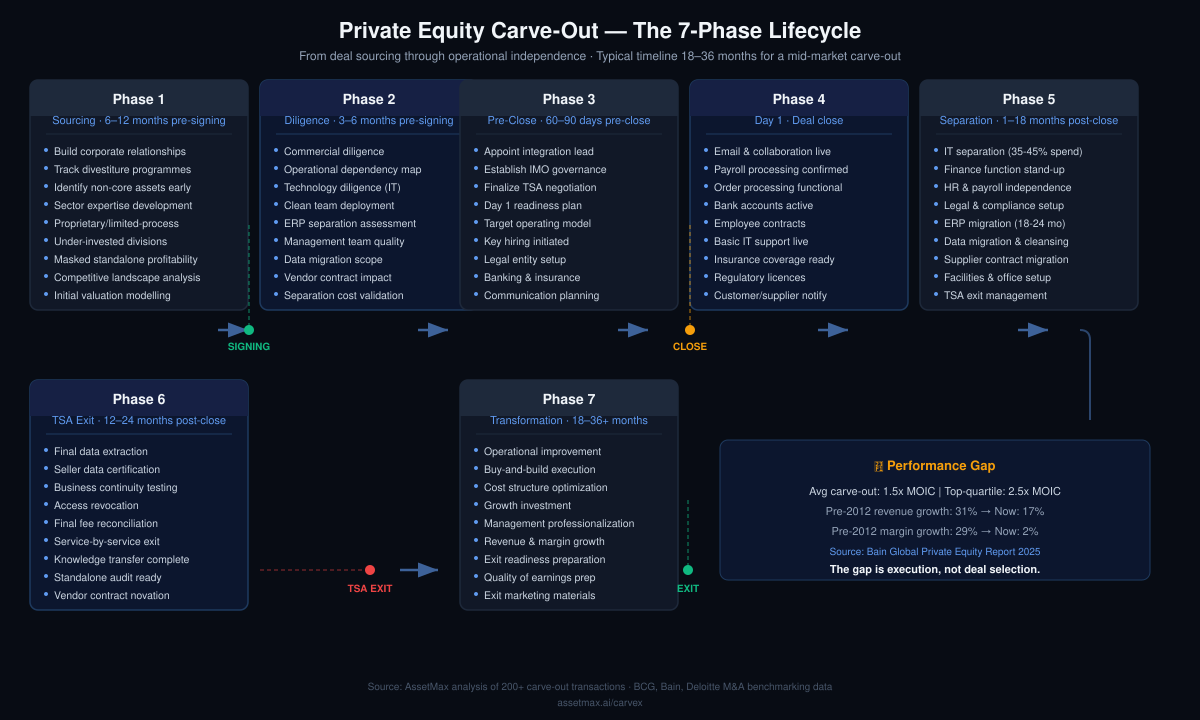
Phase 1: Sourcing & Origination (6–12 Months Before Signing)
Corporate carve-outs do not appear on a deal sheet. They are sourced through relationships, sector expertise, and proactive corporate dialogue.
- Develop corporate relationships at the business unit and corporate development level
- Track corporate divestiture programmes and portfolio reviews
- Build sector expertise that allows you to identify non-core assets before they come to market
- Maintain dialogue with corporates even when they are not actively selling; the best carve-outs are proprietary or limited-process deals
What to look for:
- Divisions that are clearly non-core to the parent’s stated strategy
- Businesses that have been under-invested relative to their market opportunity
- Situations where the parent’s cost structure masks the division’s standalone profitability
- Industries where the parent’s scale provides no competitive advantage to the division (and may actually constrain it)
Phase 2: Due Diligence & Deal Structuring (3–6 Months Before Signing)
Carve-out due diligence is fundamentally different from standard M&A diligence. The buyer must diligence two things simultaneously: the business itself, and the separation required to own it.
Commercial diligence: Is this a good standalone business? How much of its current performance depends on the parent’s brand, purchasing power, customer relationships, or shared services? What is the addressable market as a standalone entity?
Operational diligence: What shared services does the business depend on? Map every dependency: IT, HR, finance, procurement, legal, facilities. What is the quality of the management team? Who will stay and who will need to be replaced?
Technology diligence (critical and often underweighted): Complete application inventory with dependency mapping. Infrastructure topology: what is shared, what is dedicated, and what needs to be built. ERP separation complexity assessment. Data migration scope. Third-party vendor contract impact.
The clean team: For carve-outs, a clean team is essential. This is a small group of internal and external specialists who can access detailed seller data pre-close under confidentiality restrictions. The clean team identifies shared dependencies, validates separation costs, and builds the operational separation plan using real data rather than seller-provided summaries. A clean team that starts 60 days before close can save 6+ months of post-close execution time and £500K+ in avoided TSA amendments.
Phase 3: Pre-Close Planning (60–90 Days Before Close)
The window between signing and closing is the most valuable planning period in the entire carve-out lifecycle. Bain’s research on top-quartile carve-outs found that leading firms invest heavily in pre-close planning: every week of separation planning completed before close saves two to three weeks of execution time after close.
Critical pre-close activities:
- Appoint the integration lead and establish the Integration Management Office (IMO)
- Finalize the TSA negotiation: scope, pricing, service levels, exit criteria
- Build the Day 1 readiness plan: what must be operational the moment the deal closes
- Establish the target operating model: which functions will be in-house vs. outsourced
- Begin key hiring for corporate functions that will be needed on Day 1
- Develop the separation programme plan with workstream-level detail
- Set up the carve-out’s legal entity structure, banking, and insurance
- Begin customer and supplier communication planning
Phase 4: Day 1 Readiness (Close)
Day 1 is the moment the deal closes. The business must be able to operate from this point, even though full separation is months away. The most expensive mistakes happen when Day 1 items are discovered on Day 1 rather than planned for in advance.
Day 1 non-negotiables checklist:
- Email and basic collaboration tools operational
- Payroll processing confirmed
- Customer order processing functional (even if on seller systems via TSA)
- Bank accounts active and accessible
- Employee contracts transferred
- Basic IT support available
- Insurance coverage in place
- Regulatory licences confirmed or interim arrangements documented
Day 1 common failures:
- Email does not work for some users
- Payroll cannot process because employee data was not transferred correctly
- Customers receive invoices from the wrong legal entity
- The TSA is signed but the seller’s operational teams did not get the memo and deny access requests
- Key employees show up to work and cannot log in to any systems
Phase 5: Separation Execution (Months 1–18 Post-Close)
This is the heavy lift. Each shared dependency must be unwound; each corporate function must be stood up; each system must be migrated or replaced. The separation is organized into these workstreams:
- IT separation: Infrastructure, applications, data, security, end-user services — typically 35–45% of total separation spend and the longest-lead workstream
- Finance stand-up: General ledger, AP/AR, payroll, tax, treasury, financial reporting
- HR stand-up: Payroll processing, benefits, recruiting, performance management
- Legal and compliance: Entity structure, regulatory licences, contracts, IP
- Procurement: Supplier contracts, purchasing, vendor management
- Facilities: Office space, warehousing, physical security
Deloitte’s M&A integration cost survey found that IT separation accounts for the largest single share of carve-out integration costs. KPMG’s 2026 research confirms: IT separation accounts for 40–60% of total separation budgets, and 47% of deals that fail do so because of IT challenges.
Phase 6: TSA Exit & Independence (Months 12–24 Post-Close)
TSA exit is the final milestone. When the last TSA service is exited, the carve-out is fully independent. A successful TSA exit requires:
- All shared services replaced or migrated
- Data fully extracted from seller environments
- Seller data certified as deleted
- Business continuity tested on the standalone environment
- User access to seller systems revoked
- Final fee reconciliation and settlement
For a detailed TSA guide covering negotiation, pricing, service levels, and exit planning, see our companion post: TSA in M&A: The Complete Guide to Transitional Service Agreements.
Phase 7: Operational Transformation (Months 18–36+)
Once the business is independent, the focus shifts from separation to value creation:
- Implement the operational improvement programme that justified the deal
- Execute the buy-and-build strategy (add-on acquisitions)
- Optimize the now-independent cost structure
- Invest in growth initiatives that the parent underfunded
- Prepare the business for eventual exit
Bain’s 2025 report found that pre-2012 carve-outs boosted revenue 31% and margins 29% during ownership. Since 2012, those figures have dropped to 17% and 2% respectively. The firms achieving top-quartile returns are those that maintain an ironclad link between the value-creation thesis and how the newly independent company is set up to achieve it — not just “standing up” the business and hoping growth follows.
Carve-Out Economics: Costs, Timelines, and the IRR Impact

Separation Costs by Deal Size
Based on analysis of 50+ mid-market carve-outs with cross-validation against BCG and Deloitte benchmarking data:
| Deal Size (EV) | Typical Separation Cost | Cost as % of EV | Typical Timeline |
|---|---|---|---|
| £20M–£50M | £1.5M–£3.5M | 3–7% | 9–18 months |
| £50M–£200M | £3M–£10M | 3–5% | 12–24 months |
| £200M–£500M | £8M–£25M | 2–5% | 18–24+ months |
| £500M+ | £15M–£40M+ | 1–4% | 24–36+ months |
These costs cover one-time separation expenses: IT build-out, system migration, data transfer, consulting and advisory fees, TSA fees, and the cost of hiring or outsourcing corporate functions. They do not include ongoing operational costs of the standalone business.
Cost Breakdown by Workstream
| Workstream | % of Total Separation Cost |
|---|---|
| IT (infrastructure, applications, data, security) | 35–45% |
| TSA fees (monthly service charges to seller) | 15–25% |
| Finance, HR & corporate functions stand-up | 15–20% |
| Consulting & advisory (SI, legal, tax, clean team) | 10–15% |
| Facilities & physical infrastructure | 5–10% |
| Programme management & governance | 5–8% |
The IRR Impact of Timeline Delays
A delayed carve-out does not just cost more in separation spend — it destroys value across multiple dimensions:
- TSA extensions: £50K–£500K per month depending on deal size
- Delayed synergy capture: Every month of duplication delay postpones the realization of deal-model synergies
- Management distraction: The management team spends time on separation logistics rather than running and growing the business
- Talent attrition: Prolonged uncertainty drives out key people who would have stayed if the transition had been faster
- Customer and supplier confidence: Extended transitions create perception of instability
The Journal of Private Equity study found that carve-out transactions underperformed their investment thesis by an average of 340 basis points in IRR when IT separation exceeded 18 months. In PE, where a few hundred basis points separate top-quartile from bottom-quartile funds, carve-out execution capability is genuinely a source of competitive advantage.
The Carve-Out Team: Who You Need and How to Resource It
The Core Team
A carve-out requires a dedicated team that does not exist in most PE firms or portfolio companies:
- Deal lead (pre-close): Sources and negotiates the deal. Transitions responsibility to the integration lead at signing.
- Integration lead (post-signing): Owns the separation programme from signing through TSA exit. Reports to the investment committee and the portfolio company board.
- Clean team lead: Manages the pre-close dependency discovery and separation planning under confidentiality restrictions.
- IT separation lead: Owns the technology separation workstream (infrastructure, applications, data, security).
- Finance stand-up lead: Builds the standalone finance function (general ledger, AP/AR, payroll, tax, treasury).
- HR transition lead: Manages employee transfers, benefits transitions, and corporate function hiring.
- TSA manager: Dedicated role to manage the TSA relationship, track service levels, and drive exit milestones. This is a role many firms overlook, and its absence is a leading cause of TSA overruns.
- Change management lead: Owns communication with employees, customers, suppliers, and other stakeholders throughout the transition.
Build vs. Buy: The Resourcing Decision
Most PE firms do not have a carve-out team waiting on the bench. The resourcing decision is one of the most consequential in the carve-out process:
- Internal execution: Uses existing portfolio company staff or firm operating partners. Day rates are lower, but these people have day jobs, typically lack carve-out experience, and cannot dedicate full-time attention to the separation.
- System integrator (SI): The traditional option. Accenture, Deloitte, and similar firms bring methodology and capacity. They are expensive (£1,200–£2,500 per day) and often overstaffed with junior resources, but they can scale quickly.
- Boutique M&A specialist: Firms that focus exclusively on carve-out and integration execution. More senior teams, faster pace, and more relevant experience than generalist SIs. Typically £900–£1,800 per day. Best fit for mid-market PE deals.
- Hybrid model (recommended): Internal integration lead plus boutique M&A specialist for workstream leads plus tactical contractors for specific execution tasks plus SI only for commodity-scale work. Bain’s 2023 M&A integration study found that hybrid resourcing achieved integration milestones 30 percent faster than either fully internal or fully outsourced models.
Carve-Out Due Diligence: A Deeper Look
The Standard Diligence Gap
Standard financial and commercial due diligence answers whether the business is worth buying. Carve-out due diligence must also answer whether the business can be separated, at what cost, and in what timeframe. The most expensive mistakes in carve-outs almost all trace back to diligence gaps:
- IT dependency gaps: Shared ERP instances, embedded applications, shadow IT, data centre co-location. BCG’s research indicates that the average mid-market carve-out has 20–30 percent more shared dependencies post-close than were identified pre-close.
- People gaps: The business has operational staff but no corporate functions. Finance, HR, legal, IT, procurement: all must be hired or outsourced.
- Contract gaps: Supplier contracts, customer agreements, and licences held at the parent level. Some transfer automatically; some require renegotiation; some require replacement entirely.
- Regulatory gaps: Operating licences, permits, and certifications held by the parent. The carve-out needs its own.
The Clean Team in Detail
The clean team is the most underutilized tool in carve-out diligence. A properly structured clean team has:
- Composition: 2–3 senior IT architects, 1–2 finance/operations specialists, 1 legal/compliance advisor, all bound by strict confidentiality agreements
- Access: Full access to seller’s systems, documentation, and personnel for the specific purpose of separation planning
- Deliverables: Detailed dependency map, validated separation cost estimate, TSA scope recommendation, risk register, and a separation programme plan grounded in actual system data
- Timing: Established at signing (or ideally, during exclusive negotiations). A clean team that starts 60 days before close produces a materially better separation plan than one that starts 30 days before close.
The TSA: Your Bridge to Independence
The Transitional Service Agreement is the most important document in any carve-out. It defines what services the seller will continue providing, for how long, at what cost, and under what conditions. FTI Consulting observes that TSAs are a double-edged sword: essential for continuity, but they “reduce execution urgency, inflate costs, and obscure accountability” if not actively managed toward exit.
A separate detailed guide to TSA strategy is available in our TSA in M&A post. Here we cover the carve-out-specific implications:
TSA Strategy for PE Carve-Outs
- Duration strategy: Push for 18 to 24 months. Under 12 months is aggressive for any carve-out involving ERP separation. Over 24 months signals to the seller that you are not serious about independence. Negotiate service-specific durations: email can exit in 3 months, ERP needs 18.
- Pricing strategy: Cost-plus is standard. The critical negotiation is the definition of “cost.” Define it exhaustively: direct labour at named-role rates, infrastructure at specific resource costs, third-party at pass-through with invoices, and a defined overhead allocation cap.
- Extension strategy: Most carve-outs need at least one extension. Agree on extension pricing in the original TSA (e.g., base rate plus 10 percent) and insist on month-to-month flexibility rather than block commitments.
Critical TSA Clauses
- The seller must provide reasonable cooperation for knowledge transfer, including access to subject matter experts and documentation
- The buyer has the right to audit the seller’s TSA cost base and service levels
- The seller must maintain service quality at pre-close levels and provide monthly service-level reports
- Upon TSA exit for each service, the seller must certify in writing that all buyer data has been deleted
- Change requests must be priced according to a pre-agreed rate card, not negotiated ad-hoc
The TSA Manager: The Role That Pays for Itself
One of the highest-return investments in any carve-out is appointing a dedicated TSA manager. This person manages the day-to-day TSA relationship with the seller, tracks service-level compliance, monitors TSA spend against budget, coordinates change requests, and drives the TSA exit process for each service. Without a dedicated TSA manager, these responsibilities fall to the integration lead — who is already managing the separation programme — and TSA management gets attention only when something goes wrong.
Post-Close: The First 100 Days
The first 100 days after close set the trajectory for the entire carve-out:
Days 1–30: Stabilise.
- Confirm all Day 1 systems are operational
- Establish the IMO and integration governance
- Initiate TSA governance (first operational review within 2 weeks)
- Begin corporate function hiring
- Communicate with all employees, key customers, and critical suppliers
Days 31–60: Mobilise.
- Staff all separation workstreams
- Stand up the TSA exit tracking dashboard
- Begin IT separation detailed planning
- Initiate ERP migration planning (the longest workstream)
- Start quick-win exits (email, collaboration tools)
Days 61–100: Execute.
- Exit commodity IT services (email, help desk, basic infrastructure)
- First data migration cycles
- Begin finance and HR function stand-up
- First monthly TSA governance review with comprehensive service-level data
How AssetMax Supports PE Carve-Outs
At AssetMax, we built CarveX specifically for the hardest transaction type in private equity: the corporate carve-out. Our platform addresses the three dimensions that make or break carve-out execution:
- Pre-close intelligence. CarveX maps the target’s entire IT landscape (applications, infrastructure, data, security) in 5 to 10 days, identifying shared dependencies that standard diligence misses. Clients using CarveX pre-close typically identify 30 to 50 percent more shared dependencies than firms relying on standard diligence alone.
- Separation execution. CarveX’s sequencing engine models the optimal order of separation activities to minimize TSA duration and business disruption. The dependency mapping updates in real time as new shared services are discovered or migration timelines shift — preventing the cascading delays that characterize most carve-outs.
- TSA management. CarveX provides a dedicated TSA tracking dashboard with service-level monitoring, spend tracking, exit date forecasting, and automated alerts when milestones are at risk. Clients exit TSAs 30 to 50 percent faster than industry averages, reducing total TSA costs by 15 to 25 percent.
Beyond CarveX, AssetMax’s broader platform supports the full PE carve-out lifecycle:
- Diligize accelerates commercial and operational due diligence, compressing the diligence timeline and surfacing risks earlier
- Praetorian provides continuous cybersecurity monitoring during the vulnerable transition period when networks and access controls are in flux
- Kepler supports the operational transformation phase post-independence with performance analytics and value creation tracking
- ExitSmart prepares the now-independent business for eventual exit with sell-side readiness analytics
For PE firms executing carve-outs, the combination of pre-close intelligence, separation execution tools, and TSA management is the difference between a deal that meets its investment thesis and one that does not.
Frequently Asked Questions
What is a private equity carve-out?
A private equity carve-out is the acquisition of a division, business unit, or set of assets from a larger corporate parent by a private equity firm, where the acquired entity will operate as a standalone company. Unlike a standard acquisition where the target already operates independently, a carve-out requires the buyer to create a fully independent company — building corporate functions, IT systems, and legal structures from the ground up while the business continues to operate.
How is a carve-out different from a spin-off?
A carve-out sells the business unit to a new owner (typically a PE firm), while a spin-off distributes shares of the separated unit to the parent company’s existing shareholders. In a carve-out, the parent receives cash; in a spin-off, shareholders receive equity. Carve-outs are more common in PE because they allow the buyer to acquire a business at a complexity discount and transform it under focused ownership.
How long does a carve-out take?
The full carve-out lifecycle — from sourcing to full operational independence — typically spans 18 to 36 months. The separation execution phase alone takes 9 to 24+ months depending on deal size and complexity. A £20M–£50M EV carve-out can separate in 9–18 months, while a £500M+ transaction may require 24–36 months. ERP migration is consistently the longest workstream, often taking 18–24 months on its own.
How much does a carve-out cost?
Separation costs typically range from 1–7% of enterprise value. A £20M–£50M deal might cost £1.5M–£3.5M to separate, while a £500M+ transaction can cost £15M–£40M+. IT represents 35–45% of total separation costs, and TSA fees add 15–25%. These are one-time separation costs; they do not include ongoing operational costs of the standalone business.
What is a TSA in a carve-out?
A Transitional Service Agreement (TSA) is a contract under which the parent company continues providing specified services — IT, payroll, accounting, HR, facilities — to the carved-out entity for a defined transition period after the sale closes. TSAs typically run 12 to 24 months. They are essential for business continuity but represent a significant cost (15–25% of total separation spend) and must be actively managed toward exit.
Why do carve-outs fail?
The six most common reasons carve-outs fail are: (1) inadequate pre-close diligence that misses shared dependencies, (2) unrealistic separation timelines that force expensive TSA extensions, (3) ERP migration delays that cascade through every workstream, (4) talent flight as key people leave during uncertainty, (5) TSA mismanagement where the buyer treats the TSA as a safety net rather than a ticking clock, and (6) underinvestment in change management. KPMG research indicates that 47% of deals fail due to IT challenges specifically.
What returns do carve-outs generate for PE firms?
According to Bain’s 2025 Global Private Equity Report, average carve-out deals since 2012 have delivered 1.5x MOIC — slightly below the average for all buyouts. However, top-quartile carve-outs still achieve 2.5x MOIC. The gap between average and top-quartile is driven by execution quality: leading firms invest heavily in pre-close planning, use clean teams for dependency discovery, and maintain an explicit link between their value-creation thesis and the separation plan.
What is a clean team in a carve-out?
A clean team is a small group of internal and external specialists (IT architects, finance/operations specialists, legal advisors) who can access detailed seller data pre-close under strict confidentiality restrictions. The clean team identifies shared dependencies, validates separation costs, and builds the operational separation plan using real system data rather than seller-provided summaries. A clean team that starts 60 days before close can save 6+ months of post-close execution time.
How do you structure the carve-out team?
The recommended model is a hybrid: an internal integration lead plus boutique M&A specialists for workstream leads plus tactical contractors for specific tasks plus a system integrator only for commodity-scale work. Bain’s research found that hybrid resourcing achieved integration milestones 30% faster than either fully internal or fully outsourced models. A dedicated TSA manager — a role many firms overlook — is one of the highest-return investments in a carve-out programme.
How has the carve-out market changed in 2025–2026?
In H1 2025, carve-outs accounted for 10.6% of US buyouts — above the five-year average of ~8.7%. With $2.51 trillion in North American dry powder, sponsors are increasingly turning to carve-outs as a path to deploy capital at reasonable multiples. However, returns have compressed: the average carve-out now delivers 1.5x MOIC versus 3.0x pre-2012. Competition has pushed up entry multiples, making execution quality — not just deal selection — the primary driver of returns.
Key Takeaways
- Carve-outs are 3–5x more complex than standard acquisitions. The complexity premium creates return potential, but only for firms that have built the execution capability to capture it.
- Due diligence is the foundation of everything. Invest in comprehensive shared-services discovery. Use a clean team. Discover dependencies before you sign the TSA, not after.
- The TSA is your most important document. Negotiate it like a deal term, not an administrative afterthought. Define cost, service levels, exit criteria, and extension pricing exhaustively.
- Start separation planning before close. Every week of planning completed pre-close saves two to three weeks of execution post-close. Appoint the integration lead at signing, not after.
- ERP migration is the longest pole in the tent. Plan for it realistically (18–24 months). Do not let deal-team optimism create a timeline that guarantees expensive TSA extensions.
- Dedicate a TSA manager. This single role can pay for itself many times over by preventing TSA overruns and managing the seller relationship effectively.
- Retain the target’s key people. They know the business, the systems, and where the bodies are buried. Their institutional knowledge is irreplaceable during separation.
- Communicate relentlessly. Employees, customers, and suppliers need to understand what is happening, why, and what it means for them. Uncertainty destroys value.
- Use the right resourcing model. Hybrid teams (internal lead plus boutique specialist plus tactical contractors) outperform fully internal and fully outsourced models by 30%.
- The separation is not the goal; value creation is. Exit the TSA as fast as safely possible, then pivot the organization’s attention from surviving the separation to growing the business — this is what separates the 2.5x MOIC deals from the 1.5x average.
This guide draws on practitioner experience across 200+ carve-out transactions and published research from Bain & Company’s 2025 Global Private Equity Report, BCG’s 2024 M&A Integration Benchmarking Report, Deloitte’s M&A Integration Cost Survey, McKinsey’s M&A Research Programme, KPMG’s IT Separation Research, and the Journal of Private Equity. To learn more about how AssetMax supports carve-out execution, technology due diligence, and operational separation, visit assetmax.ai/carvex or see our companion guides on Post-Merger IT Integration and TSA in M&A.