
When a special situations investor evaluates a distressed company, the balance sheet gets dissected. The P&L gets stress-tested. The customer contracts get scrutinized. But there’s one asset class that almost nobody examines with the same rigor — and it’s the one that can destroy 100% of the deal’s upside overnight: cybersecurity posture.
Distressed companies don’t just carry financial debt. They carry cyber debt — years of underinvestment in security controls, unpatched vulnerabilities, legacy systems held together with hope, and incident response plans that exist only as unopened PDFs. When you acquire a distressed target, you’re not just buying assets. You’re inheriting every breach that hasn’t been discovered yet.
This guide walks through the 10 questions every special situations investor should ask before closing — specifically calibrated for the compressed timelines, limited seller cooperation, and elevated risk profiles that define distressed M&A. But it makes one conceptual shift that most cyber diligence misses: the question is not “what cyber risks does this target carry,” but “can those risks actually be contained post-close, and how do we underwrite that before we own the asset?” A list of breach risks is not underwriting; it is a warning. Underwriting confidence comes from turning each answer into a priced, scheduled, and owned remediation — or a price adjustment that reflects it.
From Cyber Findings to Underwriting Confidence
Before the 10 questions, there is a distinction that defines whether cyber diligence protects the deal or just documents it: findings describe the risk; underwriting proves it can be absorbed. In distressed M&A, the buyer inherits every undiscovered breach. The question is not whether the target has cyber debt — it does — but whether that debt can be quantified, contained, and converted into a price adjustment or a funded remediation plan before signing.
Before signing, investors should underwrite not only the target’s security posture but also their own ability to operationalise the fixes post-close. Questions include:
- Can the security posture actually be operationalised post-close, or does it only pass diligence on paper? A written policy is not a control set; underwrite the gap between them.
- Does management have the capacity to execute the remediation plan? Who owns the fixes, and do they have the authority and budget to deliver them inside the compressed hold period?
- Are the remediation costs priced into the deal, or appended as a footnote? A breach that will cost $2 million to contain is not a finding — it is a line item in the bid.
- Are the key IT and security leaders retained? The people who understand the legacy systems and unresolved incidents are the ones most likely to be recruited away at close.
- Which assumptions underpinning the investment model depend on the security posture holding? If the return case assumes no material incident during the hold, the model is only as strong as that assumption.
- What evidence supports the expected timing and cost of remediation? External scanning, breach database checks, and clean-team validation — not the seller’s assurances.
If you cannot answer these with evidence before close, you are cataloguing cyber risk — you are not underwriting it. The 10 questions that follow are built to turn each answer into a defensible position, so diligence translates directly into underwriting confidence rather than a list of red flags that gets filed and forgotten.
Security is one workstream inside the wider technology review — see the technology risk framework for special situations, the IT due diligence checklist, and the pre-acquisition security audit checklist for the audit sequence.
Why Cybersecurity Due Diligence Fails in Distressed Deals
Before we get to the questions, it’s worth understanding why cyber DD so often gets sidelined — and the specific failure patterns that make distressed deals uniquely dangerous.
Failure Pattern #1: The “It’s Just a Balance Sheet Play” Fallacy
Distressed investors often frame the opportunity as purely financial — buy the debt at 40 cents, restructure the capital stack, exit at par. But in 2026, every company is a technology company with a digital attack surface. Even a manufacturing business with 50-year-old machinery runs on ERP systems, processes customer PII, manages supplier portals, and stores intellectual property in cloud or hybrid environments. A single ransomware attack can halt production for 2–4 weeks — destroying the very EBITDA you’re underwriting.
Failure Pattern #2: Timeline Compression Kills Scope
Distressed deals move fast. A 2-week exclusivity window is common. But comprehensive cyber DD — the kind that includes penetration testing, code review, and architecture assessment — typically takes 4–8 weeks. Under time pressure, buyers default to a “compliance checkbox” approach: ask for the SOC 2 report, confirm antivirus is installed, and move on. That’s not diligence. That’s due negligence.
Failure Pattern #3: Seller Stonewalling
Distressed sellers — particularly those in bankruptcy or near-bankruptcy — often lack the staff, access, or incentive to cooperate with technical assessments. The CISO may have been laid off months ago. System documentation may not exist. The IT team that built the infrastructure may have departed. And the seller’s counsel will push back on any testing that could “disrupt operations” — even though the real concern is that testing will reveal liabilities they’d rather not quantify.
Failure Pattern #4: The “We’ll Fix It Post-Close” Trap
This is the most expensive one. Investors assume they’ll discover and remediate cyber issues after closing. But post-close remediation in a distressed target is dramatically harder than in a healthy acquisition: the IT team is skeleton-staffed or outsourced, documentation is missing, legacy systems can’t be patched without breaking critical workflows, and you’re trying to integrate while simultaneously firefighting. According to IBM’s 2025 Cost of a Data Breach report, the average breach costs $4.45 million — but that’s for an organization with functioning detection and response capabilities. In a distressed target, detection may take months, and containment may be impossible without rebuilding from scratch.
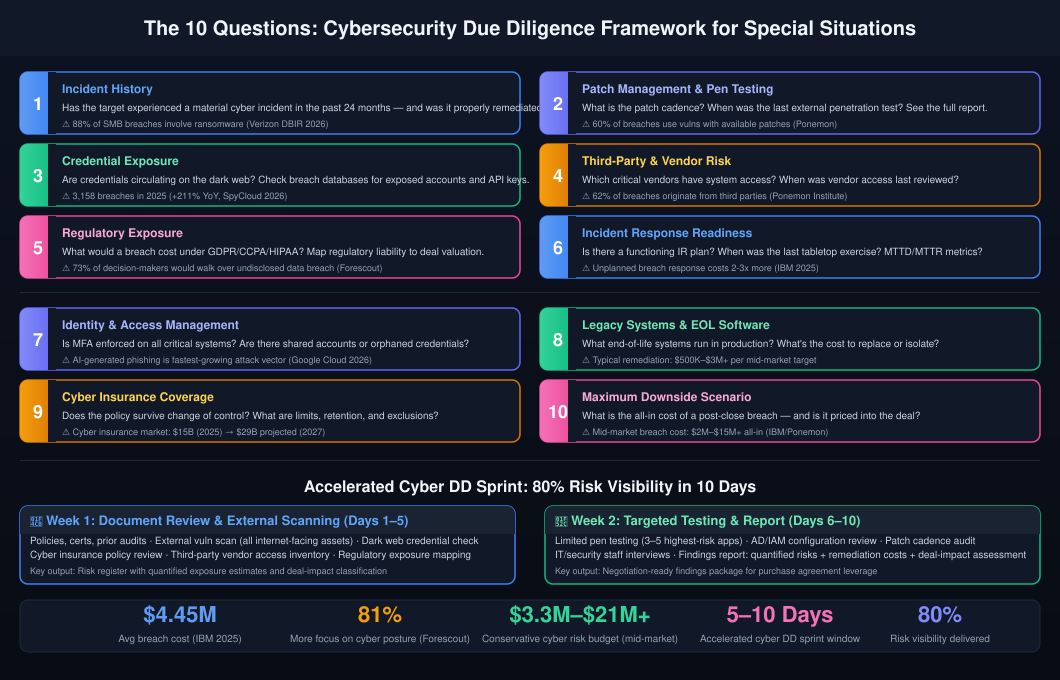
The 10 Questions Every Investor Should Ask
These questions are designed for the realities of special situations: limited access, compressed timelines, and the need to separate deal-breakers from negotiable findings.
1. Has the target experienced a material cyber incident in the past 24 months — and if so, was it properly remediated?
This is the first question because the answer changes everything. A target that suffered a ransomware attack 8 months ago — even if they “recovered” — may still have persistent access paths, unremediated vulnerabilities, and compromised credentials circulating on dark-web markets. Ask for incident response reports, post-mortem documentation, and evidence of root-cause remediation. If they can’t produce these, assume the incident was never fully resolved.
According to the 2026 Verizon DBIR, ransomware was involved in 88% of breaches at small and mid-sized businesses — precisely the targets that populate distressed portfolios. A prior incident that wasn’t properly closed is a ticking time bomb.
2. What does the patching and vulnerability management program look like — and when was the last external penetration test?
Patch cadence is one of the most reliable proxies for overall cyber maturity. Ask:
- What is the mean time to patch (MTTP) for critical vulnerabilities?
- Is there an inventory of all internet-facing assets?
- When was the last third-party penetration test, and can you see the full report (not just the executive summary)?
- Are there known unpatched critical vulnerabilities in production systems?
In distressed targets, expect MTTP measured in months, not days. A 2025 Ponemon Institute study found that 60% of breaches involved vulnerabilities for which a patch was available but not applied. If the target hasn’t been patching, the attack surface is wide open.
3. Are credentials from the target’s domain already circulating on the dark web or in breach databases?
This is a quick, high-signal check that can be performed without target cooperation. Services like Have I Been Pwned’s domain search, SpyCloud, and DeHashed can reveal whether employee credentials, API keys, or service account tokens have been exposed. If the target has 500 employees and 200 of their corporate email/password pairs are already in breach databases, you’re looking at an organization with no credential hygiene — and likely active account takeover risk.
SpyCloud’s 2026 Identity Exposure Report found that 3,158 publicly reported data breaches occurred in 2025 — a 211% year-over-year increase. Credential reuse means every one of those breaches potentially compromises the target’s accounts.
4. What does the third-party and vendor risk landscape look like — and which critical vendors have access to the target’s systems?
In distressed targets, vendor management is often nonexistent. Key suppliers may have VPN access that hasn’t been reviewed in years. Former contractors may still have active accounts. Integration partners may have direct database access. 62% of breaches originate from third parties (Ponemon Institute), and distressed companies — which have typically gone through rounds of contractor hiring and firing — are especially exposed.
Map the critical vendor list. For each vendor with system access, ask:
- What level of access do they have?
- Is MFA enforced for vendor accounts?
- When was access last reviewed?
- Are there former vendors whose access was never revoked?
5. What regulatory exposure does the target carry — and what would a breach cost under GDPR, CCPA, or sector-specific frameworks?
Regulatory risk is often invisible on the balance sheet. A mid-market European manufacturer holding customer PII faces GDPR fines of up to €20 million or 4% of global annual turnover — whichever is higher. A US healthcare-adjacent business could face HIPAA penalties of $50,000+ per violation. These aren’t hypothetical. They’re quantifiable liabilities that should be factored into your valuation model just like environmental liabilities or pension obligations.
The Forescout 2025 M&A Cybersecurity Report found that 73% of decision makers said an undisclosed breach of personal data would be an immediate deal-breaker. If the target handles PII, PHI, or PCI data, regulatory exposure should be one of your top 3 diligence priorities.
6. Is there a functioning incident response plan, and when was it last tested?
A plan that hasn’t been tabletop-tested in the past 12 months is not a plan — it’s a wish. Ask for:
- The incident response plan document (not just confirmation that it exists)
- Records of the last tabletop exercise or simulation
- The incident response retainer with an external firm (if any)
- Mean time to detect (MTTD) and mean time to respond (MTTR) metrics
Distressed targets almost universally fail this test. When cash is tight, tabletop exercises are the first thing cut. This means that if a breach occurs post-close, the response will be improvised — and improvisation in incident response costs roughly 2–3x more than a planned response, per IBM’s benchmark data.
7. What is the state of identity and access management? Is multi-factor authentication enforced across all critical systems?
IAM is the front door. If MFA isn’t enforced on email, VPN, admin consoles, and cloud platforms, the organization is one phished password away from a catastrophic breach. In distressed targets, you’ll often find:
- Shared admin accounts with no individual accountability
- Former employees with still-active access
- No single sign-on (SSO) — dozens of disconnected identity silos
- No privileged access management (PAM) for critical systems
- Default credentials on operational technology or IoT devices
Google Cloud’s 2026 Cybersecurity Forecast identified AI-generated phishing and deepfakes as the fastest-growing attack vector, making MFA — particularly phishing-resistant MFA like hardware security keys — the single most impactful control you can verify in due diligence.
8. What legacy systems or end-of-life software is running in production — and what would it cost to replace or isolate them?
Distressed companies run on legacy. Windows Server 2012 (end of support October 2023). Unsupported ERP versions. Custom applications written by developers who retired 5 years ago. Industrial control systems that can’t be patched without voiding manufacturer warranties.
Each end-of-life system is an unpatchable vulnerability. Create an inventory of EOL systems and estimate two numbers:
- Cost to replace or upgrade — often $500K–$3M+ for mid-market ERP or infrastructure refreshes
- Cost to isolate — network segmentation, application-layer firewalls, and compensating controls if replacement isn’t immediately feasible
These costs should be line items in your post-close budget, not surprises discovered during integration.
9. What cyber insurance coverage exists, and would it actually respond to a post-acquisition incident?
Cyber insurance is not automatically transferable. Policies may contain change-of-control clauses that void coverage upon acquisition. Even if the policy survives, the coverage limits may be inadequate for the target’s actual risk profile. Key questions:
- What is the current cyber insurance policy limit and retention/deductible?
- Does the policy include ransomware coverage, business interruption, and regulatory defense?
- Is there a change-of-control clause that would void coverage post-acquisition?
- Has the target made any cyber insurance claims in the past 3 years?
The cyber insurance market reached approximately $15 billion in premiums in 2025, with projections of $29 billion by 2027 (DeepStrike, 2026). But coverage is getting harder to obtain — especially for companies with weak security posture. If the target’s policy is minimal or voidable, factor $500K–$2M in first-year cyber insurance costs into your post-close budget.
10. If we discover a material breach post-close, what’s our maximum downside — and is it priced into the deal?
This is the question that ties it all together. Build a conservative downside scenario:
- Direct costs: Ransom payment (if applicable), forensic investigation ($150K–$500K), legal counsel ($100K–$300K), notification costs ($5–$15 per record)
- Business interruption: Revenue loss during downtime (2–4 weeks for typical ransomware recovery, 6+ weeks for severe incidents)
- Regulatory penalties: GDPR/CCPA fines, sector-specific penalties
- Reputational impact: Customer churn, supplier confidence erosion, difficulty recruiting
- Management distraction: The hidden cost — your turnaround team is now managing a breach instead of executing the value creation plan
For a mid-market company ($50M–$200M revenue), the all-in cost of a material breach typically ranges from $2M to $15M+, depending on data volume, regulatory exposure, and business interruption duration. If that number isn’t reflected in your purchase price or holdback provisions, you’re writing the seller a free put option on your returns.
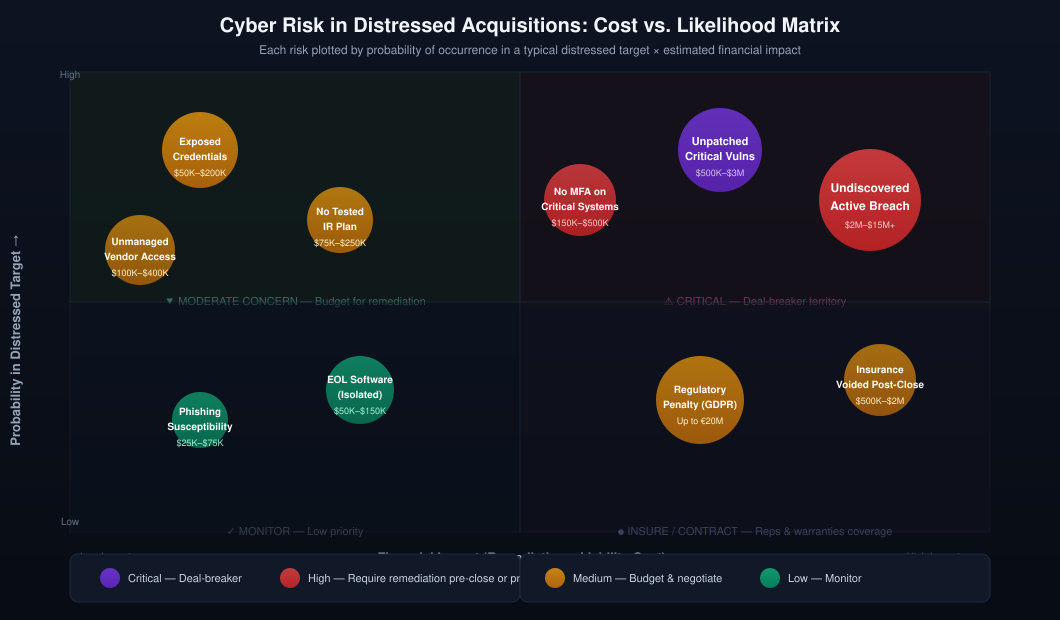
Cyber Risk in Distressed Targets: The Cost Reality
Cybersecurity issues in distressed acquisitions aren’t theoretical. They have hard dollar costs that should be modeled into every deal:
| Risk Category | Typical Finding in Distressed Targets | Estimated Remediation Cost Range | Timeline |
|---|---|---|---|
| Legacy system replacement | 1–3 end-of-life ERP/infrastructure platforms | $500K–$3M+ | 6–18 months |
| MFA and IAM overhaul | No MFA on critical systems; shared accounts | $100K–$400K | 3–6 months |
| Vulnerability remediation | Unpatched critical vulns; no patch management program | $150K–$600K | 3–12 months |
| Incident response program | No tested IR plan; no retainer | $75K–$250K | 2–4 months |
| Cyber insurance gap | Minimal or voidable coverage post-close | $500K–$2M in first-year premiums | Immediate |
| Active breach response | Undiscovered compromise at time of close | $2M–$15M+ all-in | 1–6 months |
| Total cyber risk budget (conservative) | $3.3M–$21M+ |
Sources: IBM Cost of a Data Breach 2025, Ponemon Institute, author analysis of mid-market M&A cyber remediation programs. Ranges reflect $50M–$200M revenue targets.
How to Execute Cyber DD on a Compressed Timeline
The standard objection is “we don’t have 6 weeks for a full security assessment.” You don’t need 6 weeks. A focused cyber DD sprint can deliver 80% of the value in 5–10 business days by prioritizing the highest-signal checks:
Week 1: Document Review & External Scanning (Days 1–5)
- Review existing policies, certifications (SOC 2, ISO 27001), and prior audit reports
- Run external vulnerability scans on all known internet-facing assets
- Check dark web/breach databases for exposed credentials
- Review cyber insurance policy for coverage and change-of-control clauses
- Assess third-party vendor access inventory
Week 2: Targeted Technical Testing & Report (Days 6–10)
- Conduct limited penetration testing on 3–5 highest-risk applications
- Review Active Directory configuration and IAM controls
- Inspect patch management cadence and outstanding critical CVEs
- Interview remaining IT/security staff (if available)
- Deliver findings report with quantified risk, remediation costs, and deal-impact assessment
This accelerated approach won’t catch everything — but it will catch the issues that can kill a deal or destroy post-close returns.
The Special Situations Advantage: Cyber Risk as Negotiation Leverage
Here’s what the smartest special situations investors understand: cyber risk isn’t just a downside to protect against. It’s negotiation leverage. In a distressed sale, the seller is desperate to close. Cyber findings that would reduce the purchase price by 5–15% in a healthy M&A process can justify 15–25% in a distressed context — precisely because the seller has no alternative and no ability to remediate before close.
Specific negotiating positions cyber DD enables:
- Purchase price reduction: Quantify remediation costs and demand a dollar-for-dollar reduction
- Holdback/Escrow: Structure a 12–18 month holdback tied to cyber remediation milestones
- Reps & Warranties: Include specific cyber representations — not just generic “compliance with laws” language
- R&W Insurance: Carve cyber risks into the R&W policy with specific coverage triggers
- Walk-away right: If pre-close testing reveals an active, material breach, retain the right to terminate
According to the Forescout report, 81% of M&A decision makers now place more focus on a target’s cybersecurity posture than in the past — but most still don’t translate that concern into deal terms. The investors who do will be the ones who win.
Building Cyber Resilience into Your Portfolio
Cybersecurity due diligence shouldn’t be a one-time event per deal. For firms managing a portfolio of distressed and turnaround assets, a systematic approach to cyber risk monitoring creates compound advantages:
- Pre-close baseline: Establish a cyber risk score for every target before acquisition
- Post-close remediation tracking: Monitor remediation progress against the plan negotiated in the deal
- Portfolio-wide threat intelligence: Track emerging threats that could impact multiple portfolio companies simultaneously (industry-specific ransomware campaigns, supply chain vulnerabilities)
- Exit readiness: A portfolio company with documented, verifiable cyber maturity commands a higher exit multiple — cyber risk is now part of every buyer’s diligence checklist
At AssetMax, our Praetorian platform is purpose-built for this workflow — providing continuous cyber risk monitoring, pre-acquisition security assessment frameworks, and portfolio-level threat visibility specifically designed for the timelines and constraints of special situations investing.
Frequently Asked Questions
What is cybersecurity due diligence in M&A?
Cybersecurity due diligence is the process of assessing a target company’s security posture, breach history, vulnerability exposure, regulatory compliance, and cyber risk management practices before an acquisition closes. It identifies liabilities that could affect deal valuation, post-close integration costs, and ongoing operational risk.
How long does cybersecurity due diligence take?
A comprehensive cyber DD engagement typically takes 4–8 weeks, including penetration testing and in-depth architecture review. However, for distressed transactions on compressed timelines, a focused sprint assessment covering the highest-signal checks can be completed in 5–10 business days, delivering approximately 80% of the risk visibility.
Why is cybersecurity due diligence especially important in distressed M&A?
Distressed companies typically have years of underinvestment in security controls, skeleton IT staff, legacy systems running unsupported software, and no functioning incident response capability. They’re significantly more likely to have active, undiscovered breaches or vulnerabilities that will become the acquirer’s problem immediately after close.
How much does a data breach cost an acquired company?
The IBM Cost of a Data Breach 2025 report found the global average cost of a breach is $4.45 million. For a mid-market target ($50M–$200M revenue), total costs including remediation, business interruption, regulatory penalties, and reputational damage typically range from $2M to $15M+, depending on data volume and breach severity.
Can cyber insurance be transferred after acquisition?
Not automatically. Many cyber insurance policies contain change-of-control clauses that void or limit coverage upon acquisition. Policies must be reviewed for transferability during due diligence. If coverage is voidable, the acquirer should budget $500K–$2M for first-year cyber insurance premiums, depending on the target’s risk profile.
What are the most common cyber risks in distressed companies?
The five most common risks are: (1) unpatched critical vulnerabilities on internet-facing systems, (2) no multi-factor authentication on critical accounts, (3) exposed credentials in breach databases, (4) end-of-life legacy systems that cannot be patched, and (5) no tested incident response plan.
How do I negotiate cyber risk into the purchase agreement?
Key negotiation levers include: purchase price reduction for quantified remediation costs, 12–18 month holdback or escrow tied to cyber milestones, specific cyber representations and warranties, R&W insurance with cyber coverage triggers, and walk-away rights if pre-close testing reveals a material active breach.
Should I run a penetration test before acquiring a distressed company?
Yes, whenever possible. Even a limited penetration test on the 3–5 highest-risk applications or external-facing systems can reveal vulnerabilities that policy reviews and questionnaires miss. Seller resistance to basic security testing is itself a red flag and should be factored into valuation and deal terms.
What regulations create the biggest cyber liability in M&A?
GDPR (up to €20M or 4% of global turnover), CCPA (statutory damages of $100–$750 per consumer per incident), HIPAA ($50,000+ per violation), and sector-specific frameworks like PCI DSS and NYDFS cybersecurity regulations pose the largest financial exposure for acquirers inheriting non-compliant targets.
How does cyber due diligence differ from IT due diligence?
IT due diligence asks whether systems work and what they cost. Cybersecurity due diligence asks whether systems are secure and what risks they create. IT DD focuses on performance, scalability, and cost efficiency. Cyber DD focuses on vulnerability exposure, breach history, regulatory compliance, and residual risk that could impact deal value or trigger post-close liabilities.
Key Takeaways
- Cyber debt is real debt. Years of security underinvestment create liabilities as real as financial debt — and they materialize the moment you own the business.
- Distressed targets are higher-risk by definition. Skeleton IT teams, unsupported legacy systems, and no incident response capability mean every distressed acquisition carries elevated cyber risk.
- You can do high-signal cyber DD in 5–10 days. A focused sprint on the 10 questions above won’t catch everything, but it will catch the deal-breakers.
- Cyber risk is negotiation leverage. Quantified cyber findings can justify 15–25% purchase price adjustments in distressed contexts where the seller has no alternatives.
- Build cyber monitoring into your portfolio operations. Continuous cyber risk visibility — pre-close, post-close, and at exit — creates compound advantages across your portfolio.
Sources: IBM Cost of a Data Breach Report 2025; Verizon 2026 Data Breach Investigations Report; Forescout 2025 M&A Cybersecurity Report; Ponemon Institute; SpyCloud 2026 Identity Exposure Report; DeepStrike Cybersecurity Statistics 2026; NACD Cyber Risk Oversight Handbook 2026; Google Cloud Cybersecurity Forecast 2026.