
Special situations investing thrives on speed, complexity, and information asymmetry. The investors who win aren’t the ones with the most capital — they’re the ones who can see what others miss, move faster than the market, and protect value through every stage of the deal lifecycle. And in 2026, technology is the thread that runs through all of it.
This playbook maps the full special situations deal lifecycle — from sourcing to exit — through a technology lens. It’s designed for mid-market and regional special situations teams managing $500M–$5B who operate with lean teams but face the same complexity as the mega-funds. For each stage, we cover what to assess, what goes wrong, what it costs, what timeline to expect, and which tools make the difference.
Whether you’re evaluating a distressed manufacturer in Poland, executing a carve-out from a global corporate, or preparing a complex asset for exit, this is the framework that connects technology decisions to deal outcomes.
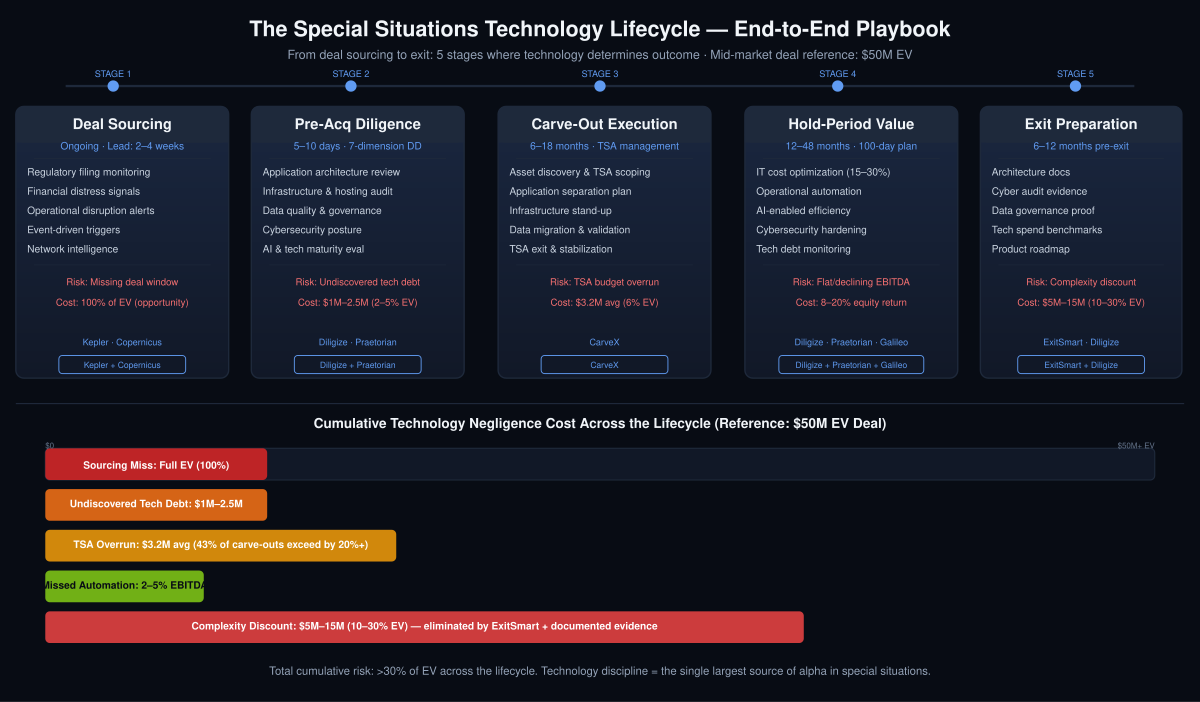
The Special Situations Technology Lifecycle: 5 Stages, One Playbook
Every special situations deal moves through five distinct stages. At each stage, technology either creates value or destroys it — there’s no neutral ground. The table below maps the full lifecycle:
| Stage | Timeframe | Primary Technology Focus | Key Risk if Neglected | AssetMax Product |
|---|---|---|---|---|
| 1. Sourcing | Ongoing | Signal detection, market monitoring, target identification | Missing the deal window entirely | Kepler, Copernicus |
| 2. Pre-Acquisition Diligence | 5–10 business days | Technology, cyber, and AI assessment | Buying an unfixable liability | Diligize, Praetorian |
| 3. Carve-Out Execution | 3–18 months | IT separation, TSA management, digital stand-up | Value leakage through TSA overruns | CarveX |
| 4. Hold-Period Value Creation | 12–48 months | Operational improvement, automation, cost optimization | Flat or declining EBITDA | Diligize, Praetorian, Galileo |
| 5. Exit Preparation | 6–12 months pre-exit | Buyer-ready evidence, vendor DD, equity story | Complexity discount at sale (10–30% valuation hit) | ExitSmart, Diligize |
Each stage builds on the last. Weak diligence creates carve-out surprises. A messy carve-out destroys hold-period value creation potential. And poor documentation throughout makes exit preparation an uphill battle. The playbook is cumulative — and the investors who treat it that way consistently outperform those who don’t.
Stage 1: Deal Sourcing — Finding Opportunity Before the Auction Starts
In special situations, the best deals never reach a formal process. They surface through regulatory filings, covenant breaches, management departures, supply chain disruptions, or whispered restructuring mandates. The investors who get the first call are those with systematic early-warning systems — not those relying on investment bank pitch books.
According to Bain & Company’s Global Private Equity Report 2026, $1.3 trillion in buyout dry powder sits undeployed globally. That capital is chasing a finite set of high-quality deals — and special situations, where complexity deters competition, remains one of the few corners of the market where proprietary sourcing still generates genuine alpha.
The Technology-Enabled Sourcing Stack
Leading special situations teams operate a multi-layered sourcing infrastructure:
- Regulatory & legal signal monitoring: SEC filings, antitrust reviews, bankruptcy dockets (Chapter 11, §363 sales), NCLT proceedings in India, EU merger control notifications. These are the earliest objective signals of pending transactions or distress.
- Financial distress indicators: Covenant breaches (tracked via credit rating downgrades, loan amendments, waiver requests), payment defaults, going-concern notes in audit opinions, sudden auditor resignations.
- Operational disruption signals: Supply chain disruptions, plant closures, force majeure declarations, major customer losses, management departures — especially CFO or COO exits from PE-backed companies approaching end of fund life.
- Event-driven triggers: Regulatory changes that force divestitures, sanctions-related asset freezes, license revocations, or competitor exits that create sudden market gaps.
- Network intelligence: Restructuring advisor deal flow, legal network referrals, interim management mandates, and industry-specific channels.
Why Sourcing Fails Without Technology
The most common failure pattern among special situations teams is reactive sourcing — waiting for the phone to ring. Mid-market teams often rely on 2–3 relationship partners and a junior analyst scanning news alerts. This works when deal flow is abundant; it fails when competition intensifies and the window narrows.
The gap between reactive and systematic sourcing is measurable. A 2025 survey by FTI Consulting found that special situations investors using technology-enabled sourcing platforms identified 2.7x more actionable opportunities than those relying on network-only approaches. The difference isn’t just quantity — it’s timing. Technology-enabled teams get 2–4 weeks of lead time before deals reach broader market awareness.
Kepler, AssetMax’s off-market deal sourcing platform, is designed for this exact workflow — monitoring regulatory filings, financial distress signals, and operational disruption indicators across global markets to surface targets before they reach competitive processes. Paired with Copernicus for real-time sentiment-scored news monitoring, the combination creates the systematic early-warning infrastructure that mid-market special sits teams need to compete with the mega-funds.
Stage 2: Pre-Acquisition Diligence — Seeing What Financial DD Misses
This is where most special situations value is won or lost before the deal even closes. Standard financial due diligence — quality of earnings, working capital analysis, debt structure review — tells you what the company’s books say. It doesn’t tell you whether the ERP system is held together by spreadsheet macros, whether the cybersecurity posture is a breach waiting to happen, or whether the “AI-enabled” product is actually a rules engine from 2014.
Distressed and stressed assets have neglected technology by definition. Their IT systems, cybersecurity protocols, data architecture, and technology teams have typically been under-invested in for years — sometimes decades. The question isn’t whether there are technology issues. It’s whether those issues are fixable, at what cost, and in what timeframe.
Technology Due Diligence: The 7-Dimension Framework
A rigorous special situations technology DD covers seven dimensions, each with distinct risk profiles and cost implications:
| Dimension | Key Questions | Common Distressed Scenario | Typical Remediation Cost |
|---|---|---|---|
| 1. Application Architecture | What systems run the business? Are they documented? | Undocumented legacy ERP with custom patches | $250K–$2M+ |
| 2. Infrastructure & Hosting | On-prem or cloud? What’s the refresh status? | Aging on-prem servers past end-of-life | $150K–$1.5M |
| 3. Data Architecture & Quality | Is data clean, accessible, governed? | Fragmented spreadsheets, no single source of truth | $100K–$750K |
| 4. Cybersecurity Posture | When was the last audit? Any breach history? | No penetration test in 3+ years, no SOC 2 | $100K–$500K+ |
| 5. AI & Technology Maturity | Is AI real or marketing? What’s the tech debt? | “AI” is actually a 2014 rules engine | $200K–$1M+ |
| 6. IT Organization & Talent | Who runs tech? What’s the bus factor? | Single IT manager with all institutional knowledge | $150K–$400K/year |
| 7. Compliance & Regulatory | GDPR, SOC 2, HIPAA, industry-specific? | No data processing agreements, GDPR exposure | $50K–$300K |
A McKinsey study of technology due diligence findings across 200+ PE transactions found that 60% of targets had material technology issues not identified in financial DD, and the average remediation cost was 2–5% of enterprise value for distressed assets. For a $50M EV deal, that’s $1M–$2.5M in surprise costs — directly affecting returns.
Why Technology DD Fails in Special Situations
Three failure patterns recur across special situations transactions:
- The “We’ll Figure It Out Post-Close” Trap: When the deal window is 10 days and the seller is uncooperative, the temptation to defer technology assessment is enormous. The problem: post-close, you’ve lost all negotiating leverage. Every dollar of unknown tech debt becomes your problem. A distressed German automotive supplier acquired in 2024 discovered post-close that its ERP migration would cost €4.2M — nearly 12% of the purchase price — because technology DD was deprioritized during a compressed 8-day diligence window.
- The “IT Is Just IT” Assumption: Many investors treat technology as a back-office function — servers, laptops, help desk. In reality, technology is the operating backbone. A manufacturing target’s entire production scheduling, quality control, and supply chain management may depend on a single 20-year-old system maintained by one person. If that system fails, the business stops.
- The “Check-the-Box” DD: Running a generic IT checklist (how many servers? what ERP?) without understanding the business context produces a report that adds zero value. Technology DD for a distressed manufacturer looks completely different from technology DD for a carve-out of a SaaS division. The DD must be conditioned on the specific deal thesis.
Diligize, AssetMax’s independent technology due diligence platform, was purpose-built for this reality — delivering rapid, thesis-aligned technology assessments in 5–10 business days, not 4–6 weeks. For cyber-specific risk screening, Praetorian provides pre-acquisition security audits that identify breach liabilities, compliance gaps, and ransomware exposure before the SPA is signed.
Cybersecurity Due Diligence: The Non-Negotiable
Distressed companies are disproportionately targeted by ransomware operators precisely because their defenses are weak and their incentive to pay (to avoid business interruption during a transaction) is high. A 2025 Ponemon Institute study found that companies that experienced a cyber breach during an M&A process suffered an average 8% reduction in deal value. For special situations investors buying assets that are already under stress, the margin for absorbing a cyber incident is close to zero.
At minimum, pre-acquisition cyber diligence should answer: (1) has the target experienced a breach in the past 24 months, and if so, was it remediated? (2) when was the last independent penetration test, and what were the findings? (3) does the target hold cyber insurance, and what does it cover? (4) are there regulatory exposure risks (GDPR penalties for EU data, CCPA for California, industry-specific regimes)? (5) what is the state of access controls, patching cadence, and endpoint protection?
Stage 3: Carve-Out Execution — Separating Without Bleeding Value
Corporate carve-outs are one of the highest-value — and highest-risk — special situations strategies. The acquirer buys a non-core division from a corporate parent and must separate every shared system, process, and asset within a defined TSA (Transitional Service Agreement) period. Fail to execute the separation, and the TSA costs eat your returns. Fail to stand up independent IT, and the business can’t operate.
According to Deloitte’s 2025 Carve-Out Survey, 43% of carve-outs exceed their TSA budget by more than 20%, and the average cost overrun is $3.2M for mid-market transactions. The primary driver? Underestimating the complexity of IT separation during diligence.
The Carve-Out Technology Timeline
| Phase | Timeline | Activities | Critical Risk |
|---|---|---|---|
| Pre-Close Planning | 4–8 weeks pre-close | Asset inventory, TSA scoping, separation architecture design | Incomplete asset register → missed dependencies |
| TSA Negotiation | 2–4 weeks | Define services, SLAs, pricing, exit milestones | Open-ended TSA with no exit incentives |
| Application Separation | 3–9 months | Identify shared apps, replicate or replace, migrate data | Shared ERP instances requiring full reimplementation |
| Infrastructure Stand-Up | 2–6 months | Network, servers, cloud migration, end-user compute | Underestimating bandwidth and latency requirements |
| Data Migration & Validation | 2–4 months | Extract, clean, migrate, validate, cut over | Data corruption or loss during migration |
| TSA Exit & Stabilization | 1–3 months post-exit | Decommission TSA services, resolve residual issues | Lingering dependencies not identified in scoping |
The total timeline for a mid-market carve-out typically ranges from 6 to 18 months, with IT separation costs averaging 3–8% of the deal value. The variance depends almost entirely on the complexity of the parent’s shared IT environment and the quality of pre-close separation planning.
Where Carve-Outs Fail: 4 Common Patterns
- TSA Dependency Trap: The TSA is negotiated with vague exit criteria (“reasonable efforts”) and no hard milestones. Eighteen months later, the business is still on the parent’s ERP, paying 120% of the original TSA rate, with no viable exit path. The TSA becomes a value transfer mechanism from buyer to seller.
- Hidden Shared Services: During diligence, the carve-out appears to have 12 applications. Post-close, it turns out 47 applications are shared with the parent — everything from the HR system to the quality management platform to the building access control system. Each shared dependency adds cost and timeline.
- Data Extraction Blackout: The parent restricts data extraction during the TSA period (citing data privacy concerns, system stability, or simple obstruction), and the carve-out entity operates without complete customer, supplier, or financial history. This cripples commercial decision-making for the first year of ownership.
- Underestimating People Dependencies: The three IT staff who actually understand the ERP system are parent-company employees with retention bonuses tied to staying with the parent — not the carve-out. When they leave, institutional knowledge leaves with them.
CarveX, AssetMax’s express digital separation platform, addresses these failure patterns directly — providing structured asset discovery, TSA scoping frameworks, separation architecture planning, and migration execution support designed specifically for the speed and complexity of special situations carve-outs.
Stage 4: Hold-Period Value Creation — Turning Technology into EBITDA
The hold period is where the investment thesis either proves out or unravels. For special situations investors, value creation typically requires a combination of stabilization (stop the bleeding), optimization (reduce costs, improve margins), and growth (expand revenue, enter new markets). Technology is a primary lever across all three.
Per a 2025 Grant Thornton study, approximately 90% of PE firms formulate a 100-day plan at acquisition close. For special situations, the first 100 days are even more critical — they’re often the difference between a successful turnaround and a value-destructive holding period.
The Technology Value Creation Framework
| Value Lever | Typical Impact | Timeline | Example |
|---|---|---|---|
| IT Cost Optimization | 15–30% IT spend reduction | 3–9 months | Consolidating vendors, renegotiating licenses, cloud right-sizing |
| Operational Automation | 10–25% process cost reduction | 6–18 months | Automating manual data entry, invoice processing, quality checks |
| Data-Driven Decision Making | 2–5% margin improvement | 6–12 months | Implementing BI dashboards, real-time KPI tracking |
| AI-Enabled Efficiency | 5–15% productivity gain | 6–24 months | Predictive maintenance, demand forecasting, dynamic pricing |
| Cybersecurity Hardening | Risk mitigation (avoid $1M+ incidents) | Ongoing | Penetration testing, endpoint protection, access control redesign |
The key insight from successful turnarounds: technology-driven value creation compounds. A logistics portfolio company that implements dynamic pricing AI (2% gross margin improvement), automates dispatch operations (15% labor cost reduction), and consolidates three legacy systems into one cloud platform (30% IT cost reduction) doesn’t just add those savings — it creates a fundamentally more valuable business with better margins, faster decision-making, and more defensible competitive positioning.
The Hidden Technology Destroyer: Technical Debt Accumulation
During the hold period, the most insidious value destroyer is technical debt accumulation — the slow buildup of shortcuts, deferred maintenance, and undocumented workarounds that make the technology base progressively more fragile and expensive to maintain. It’s invisible in monthly management accounts until something breaks.
Technical debt accumulates fastest in three scenarios common to special situations: (1) post-carve-out stabilization, where the focus is on “keep the lights on” rather than architectural discipline; (2) rapid add-on acquisitions, where multiple legacy systems are duct-taped together without integration investment; and (3) management transitions, where new leadership inherits undocumented systems they don’t understand.
Continuous technology monitoring is the antidote. Diligize provides ongoing technology health assessments that track technical debt, architecture stability, and IT spend efficiency across the hold period. Praetorian delivers continuous cybersecurity monitoring to prevent breach-driven value destruction. And Galileo — AssetMax’s Voice of Customer platform — ensures that technology investments actually align with what customers value, rather than what internal IT teams want to build.
Stage 5: Exit Preparation — Turning Technology Evidence into Valuation Premium
Assets bought in complex special situations are inherently harder to sell. Buyers apply a “complexity discount” — typically 10–30% of valuation — to account for the uncertainty embedded in distressed, carve-out, or turnaround situations. The discount isn’t about actual risk; it’s about perceived uncertainty. And technology evidence is the most effective tool for reducing that perception.
According to a 2025 EY survey of PE exit processes, 68% of buyers cited “incomplete or unclear technology documentation” as a factor that reduced their bid or delayed their decision. Conversely, sellers who provided structured technology evidence packages achieved 5–12% higher valuations than comparable assets without such packages.
The Buyer-Ready Technology Evidence Package
A comprehensive exit-ready technology package should answer every question a sophisticated buyer’s technology DD team will ask — before they ask it:
- Architecture Documentation: Current-state system architecture diagram, application inventory with ownership and criticality ratings, integration map showing data flows and dependencies. Updated within 6 months of exit.
- Infrastructure Assessment: Cloud/hosting topology, capacity and scalability analysis, disaster recovery test results, business continuity plan. Demonstrates operational maturity.
- Cybersecurity Evidence: Most recent independent penetration test (within 12 months), SOC 2 Type II or equivalent certification, breach history (clean or with documented remediation), cyber insurance policy summary.
- Data Governance Documentation: Data architecture, data quality metrics, GDPR/CCPA compliance evidence, data processing registry. Critical for any buyer concerned about regulatory liability.
- Technology Spend Analysis: 3-year IT spend trend, cost optimization initiatives completed and in-flight, benchmark comparison against industry peers. Shows disciplined cost management.
- Product & Technology Roadmap: 12–24 month technology roadmap with investment rationale, AI strategy and implementation status, innovation pipeline. Tells the growth story.
- IT Organization Overview: Org chart, key personnel retention status, succession plan for critical roles, vendor relationships and contract status. Demonstrates the team can execute post-transaction.
ExitSmart, AssetMax’s exit readiness platform, structures this entire evidence package — aggregating data from across the deal lifecycle (diligence findings, carve-out execution records, hold-period monitoring) into a buyer-ready format that reduces uncertainty and protects valuation. Combined with Diligize for a pre-exit technology assessment that mirrors what a buyer’s DD team will find, the combination turns technology from a source of discount into a pillar of the equity story.
The Technology Cost of Getting It Wrong
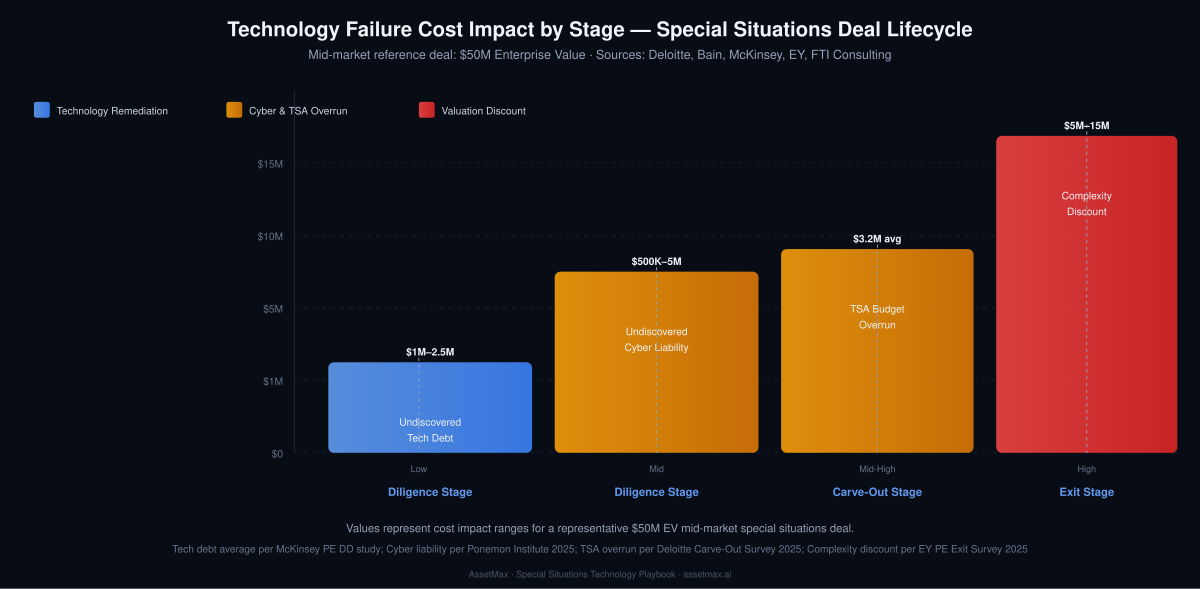
Across the five stages of the special situations lifecycle, technology failures compound. The table below quantifies what’s at stake at each stage for a representative $50M enterprise value mid-market deal:
| Stage | Failure Mode | Cost Impact | % of EV |
|---|---|---|---|
| Sourcing | Missing the deal window (reactive vs. systematic) | Opportunity cost of entire deal | 100% |
| Diligence | Undiscovered technology debt post-close | $1M–$2.5M remediation | 2–5% |
| Diligence | Undiscovered cybersecurity liability | $500K–$5M+ (breach + penalties) | 1–10% |
| Carve-Out | TSA budget overrun (20%+ over plan) | $3.2M average overrun | ~6% |
| Carve-Out | Extended TSA dependency (6+ months beyond plan) | $1.5M–$4M additional fees | 3–8% |
| Hold Period | Missed automation/optimization opportunities | 2–5% EBITDA erosion over hold | 8–20% of equity return |
| Exit | Complexity discount from poor documentation | 10–30% valuation discount | $5M–$15M on $50M EV |
The cumulative cost of technology negligence across the lifecycle can exceed 30% of deal value. Conversely, disciplined technology management through each stage can be the single largest source of alpha in special situations investing — identifying deals others miss, avoiding surprises others absorb, executing separations others overpay for, and exiting at premiums others can’t justify.
How AssetMax Maps to the Full Lifecycle
AssetMax’s product suite is purpose-built for the end-to-end special situations workflow. The table below maps each product to the stage it serves and the value it delivers:
| Product | Stage(s) | What It Does | Value to Special Sits Investors |
|---|---|---|---|
| Kepler | Sourcing | Off-market deal sourcing via regulatory, financial, and operational signal monitoring | Surfaces targets 2–4 weeks before competitive processes, 2.7x more actionable opportunities |
| Copernicus | Sourcing, Hold Period | Real-time sentiment-scored news and market intelligence | Stays ahead of market-moving events, competitor moves, and target developments |
| Diligize | Diligence, Hold Period, Exit | Independent technology & AI due diligence in 5–10 days | Identifies hidden risks, validates scalability, quantifies remediation costs before signing |
| Praetorian | Diligence, Hold Period | Cybersecurity diligence and continuous protection | Prevents buying a breach liability; ongoing protection during hold |
| CarveX | Carve-Out Execution | Express digital separation: asset discovery, TSA planning, migration | Clean separation with minimal value leakage; structured TSA exit |
| Galileo | Hold Period, Exit | Voice of Customer insights and competitive benchmarking | Validates improvement thesis; provides customer evidence for exit story |
| ExitSmart | Exit Preparation | Buyer-ready technology evidence package | Reduces complexity discount; accelerates close; protects valuation |
Why Most Technology Playbooks Fail — and How This One Is Different
Most technology playbooks for investors fall into one of two traps. They’re either (1) generic frameworks that apply equally to a growth-equity SaaS deal and a distressed manufacturing turnaround — which means they apply to neither — or (2) consulting-firm methodologies designed to sell multi-month engagements rather than deliver actionable intelligence in the compressed timeframes that special situations demand.
This playbook is different because it’s built on three principles that reflect how special situations investors actually operate:
- Speed is non-negotiable. Every framework, checklist, and cost benchmark in this playbook assumes you have days or weeks, not months. If a technology assessment takes 6 weeks, it’s useless for a deal with a 10-day exclusivity window. Everything here is designed for compressed timelines.
- The lifecycle is cumulative. Sourcing enables better diligence. Better diligence reduces carve-out surprises. Cleaner carve-outs accelerate value creation. Documented value creation powers exit premiums. Treating each stage in isolation is the single most expensive mistake special situations investors make.
- Mid-market teams can’t build this themselves. The mega-funds (Apollo, Oaktree, Cerberus) have 50-person technology teams, proprietary platforms, and dedicated carve-out specialists. Mid-market funds managing $500M–$5B have 10–20 investment professionals and maybe one operating partner with technology experience. The playbook acknowledges this reality and maps the tools that close the gap.
Frequently Asked Questions
What is a special situations technology playbook?
A special situations technology playbook is a stage-by-stage framework that maps technology decisions, risks, and tools across the full deal lifecycle — from sourcing distressed or event-driven targets through diligence, carve-out execution, hold-period value creation, and exit preparation. Unlike generic PE technology guides, it’s designed for the compressed timelines, complex deal structures, and information gaps that define special situations investing.
Why is technology due diligence different for special situations vs. traditional PE?
Special situations technology DD must be faster (5–10 days vs. 4–6 weeks), more focused on downside risk (distressed assets have neglected IT by definition), and conditioned on the specific deal structure — whether a 363 sale, carve-out, or turnaround. It also must assess remediability: is the technology fixable within the hold period and budget, or is the technical debt terminal?
How much does technology due diligence cost?
Traditional consulting-led technology DD engagements range from $75K–$250K depending on scope and target complexity. AI-enabled platforms like Diligize reduce this significantly — to $25K–$75K — while delivering results in 5–10 days instead of 4–6 weeks. The cost of skipping technology DD entirely is far higher: undiscovered remediation costs averaging 2–5% of enterprise value.
What are the biggest technology risks in a carve-out transaction?
The four biggest carve-out technology risks are: (1) TSA dependency — the carve-out can’t exit the parent’s systems within the TSA period, creating open-ended cost exposure; (2) hidden shared applications — post-close discovery that 3–5x more systems are shared with the parent than disclosed during diligence; (3) data extraction barriers — the parent restricts or delays data handover, leaving the carve-out without operational history; and (4) key person risk — the few IT staff who understand the systems are retained by the parent, not the carve-out.
How long does IT separation take in a typical carve-out?
A mid-market carve-out IT separation typically takes 6–18 months from close to TSA exit, depending on the complexity of the parent’s shared IT environment. Simple separations (standalone division with its own systems) can complete in 3–6 months. Complex separations (deeply integrated divisions sharing ERP, HR, and infrastructure with the parent) often take 12–18 months and cost 3–8% of deal value.
What technology investments create the most value during the hold period?
The highest-ROI technology investments during the hold period for special situations assets are: IT cost optimization (15–30% reduction in IT spend within 6–9 months), operational automation (10–25% process cost reduction through RPA and workflow automation), and cybersecurity hardening (risk mitigation worth $1M+ in avoided breach costs). AI initiatives tied to operational metrics — dynamic pricing, predictive maintenance, demand forecasting — have also shown measurable impact, with one logistics portfolio company achieving a 2% gross margin improvement through AI-driven pricing.
How do you reduce the complexity discount at exit?
Reducing the complexity discount at exit requires building a buyer-ready technology evidence package throughout the hold period — not scrambling to assemble it six months before exit. Key components include: current architecture documentation, independent cybersecurity audit results (within 12 months), data governance compliance evidence, a 3-year IT spend trend with industry benchmarks, and a documented technology roadmap. Sellers who provide structured technology evidence achieve 5–12% higher valuations than comparable assets without such packages, according to a 2025 EY survey.
Can mid-market special situations funds afford technology platforms like AssetMax?
Yes — and the economics are compelling. A single avoided discovery of undisclosed technical debt in a $50M EV deal (average remediation cost: $1M–$2.5M) pays for years of platform access. More importantly, technology platforms designed for mid-market funds — like AssetMax’s suite — deliver mega-fund-grade capabilities at a fraction of the cost of building equivalent systems in-house, which would require $2M–$5M+ in annual technology headcount alone.
What’s the difference between technology DD and cybersecurity DD?
Technology due diligence assesses the overall technology estate — applications, infrastructure, data, IT organization, and AI maturity — to identify risks, quantify remediation costs, and validate scalability. Cybersecurity due diligence is a focused subset that assesses breach history, vulnerability posture, compliance gaps, access controls, and ransomware exposure. Both are essential for special situations; a company with excellent technology architecture can still be a cyber liability, and vice versa.
How early should exit preparation start from a technology perspective?
Technology exit preparation should start 12–18 months before the planned exit, not 3–6 months. The most valuable technology evidence — multi-year cost trends, independent security audit history, documented architecture evolution — can only be built over time. Starting exit preparation 6 months before sale means scrambling to fill gaps; starting 12–18 months before means presenting a compelling, buyer-ready technology story that commands a premium.
Sources & Further Reading
- Bain & Company — Global Private Equity Report 2026
- Deloitte — 2025 Carve-Out Survey
- EY — PE Exit Process Survey 2025
- FTI Consulting — 2024 Special Situations Investor Survey
- Grant Thornton / PitchBook — PE 100-Day Plan Study 2025
- McKinsey & Company — Technology Due Diligence in PE Transactions
- Ponemon Institute — Cost of Cyber Incidents in M&A 2025
- Carta — Private Fund Deal Sourcing Benchmarks 2026