
The deal closed on a Friday. By Monday morning, the carve-out’s IT team discovered they could not process a single customer order. The parent company’s ERP, which the target had always relied on, required a formal TSA amendment to continue providing access. The amendment took three weeks to negotiate. During those three weeks, the business shipped late on 40% of its orders, lost two key accounts, and the seller used the chaos to extract an inflated service fee that added $2.4 million in unplanned TSA costs over the separation period.
The $180,000-a-month line item had not seemed like much during diligence. Six months later, with no exit in sight and monthly fees climbing, the deal’s IRR had already slipped by 200 basis points.
Transitional Service Agreements — or TSAs — are the scaffolding that holds a carve-out together after the deal closes. They define what services the seller will continue providing, for how long, and at what cost. They also determine what happens if the buyer misses an exit deadline, what recourse exists when services fail, and who pays for the unexpected dependencies that always emerge during separation.
And yet, in most mid-market carve-outs, the TSA is negotiated in the last two weeks before signing, drafted from a template that has not been updated since 2019, and reviewed by legal teams who understand contract law but have never managed an IT separation.
This guide is a practical playbook for getting TSAs right — written for private equity deal teams, corporate M&A professionals, operating partners, and integration leads who negotiate TSAs, live with them, and need to exit them on time and on budget. But it makes the same conceptual shift that separates a defensible deal from a PowerPoint: the question is not “how do we negotiate a TSA,” but “can we realistically exit this TSA, and how do we underwrite that before we sign?” By the time the TSA is signed, the exit assumptions are already locked in — so the work of turning execution into measurable outcomes begins during diligence, not after close.
A TSA rarely exists in isolation. It is usually the bridge that keeps a carve-out running while the wider integration proceeds, so the two are best planned together — see our private equity carve-out guide and the post-merger IT integration guide.
Can the Buyer Realistically Exit This TSA?
Before the lifecycle begins, there is a harder question the lifecycle exists to serve: can the buyer realistically exit this TSA? Most TSA guidance skips straight to “how to negotiate,” but in private equity the real test is underwriting whether the exit plan survives contact with reality. A TSA is not a pass-through cost to be minimised; it is an execution-risk instrument whose terms determine whether separation actually happens on the schedule the deal model assumes.
Before signing, investors should underwrite not only the target’s dependencies but also their own ability to deliver the separation plan the TSA commits them to. Questions include:
- Are the TSA exit assumptions realistic? Does the negotiated exit date reflect the true length of ERP migration, data extraction, and licence replacement, or is it optimism codified into a contract?
- Is management capable of executing the separation roadmap? Who owns TSA exit, and do they have the authority and M&A separation experience to hit it?
- Are key IT and business leaders retained? The people who understand the shared dependencies are the ones most likely to leave at close.
- Is the separation budget adequately provisioned? Including the hidden costs — licence true-ups, data centre exit fees, and vendor professional services — that standard models undercount.
- Which assumptions underpinning the investment model depend on a clean, on-time TSA exit? If the synergy case assumes standalone operations by month nine, the model is only as strong as that milestone.
- What evidence supports the expected timing and cost of exit? Benchmarks and clean-team validation of the dependencies, not a template clause reviewed by legal alone.
If you cannot answer these with evidence before close, you are not underwriting TSA risk; you are pricing a hope the seller is happy to sell you. The sections that follow give you the frameworks to turn each question into a defensible answer — reducing execution risk before ownership transfers, rather than discovering it after.
What Is a TSA in M&A?
The Core Definition
A Transitional Service Agreement (TSA), sometimes called a Transition Services Agreement, is a contract between the buyer and seller of a divested business unit. It obligates the seller to continue providing specific operational services to the divested entity for a defined period after the transaction closes.
TSAs exist because, in a carve-out, the target company does not stand alone. It shares IT systems, payroll processing, HR platforms, procurement accounts, facility leases, and dozens of other operational services with its former parent. Separating these shared dependencies takes time — often 12 to 24 months. The TSA bridges the gap between Day 1 independence and full operational separation.
Without a TSA, a carve-out business would effectively cease to function the moment the deal closed. No email. No payroll. No customer orders. No financial reporting. The TSA is not a nice-to-have. It is the only thing keeping the lights on.
TSA vs. Transition Services Agreement — Same Thing, Different Name
The acronym causes confusion because it refers to two identical agreements with slightly different names:
- Transitional Service Agreement (TSA): The operational services agreement discussed throughout this guide — the one that keeps IT, HR, finance, and other shared services running after close.
- Transition Services Agreement (TSA): Functionally identical. The terms are used interchangeably in practice, though “Transitional Service Agreement” is more common in European deals and “Transition Services Agreement” is more common in US deals. This guide uses TSA throughout to refer to both.
There is also a third, less common usage: some practitioners use TSA to mean “Technical Service Agreement,” which refers to ongoing maintenance and support contracts, typically in industrial or manufacturing deals. This guide addresses the M&A usage exclusively.
Why TSAs Are Not Administrative Paperwork
TSAs determine material deal economics. Specifically:
- How much the deal actually costs. TSA fees can range from $50,000 to over $500,000 per month depending on the scope of services and the complexity of the carve-out. A poorly negotiated TSA can add millions to the effective purchase price.
- How fast you can integrate. The TSA timeline sets the pace for every integration workstream. Infrastructure, applications, data migration, and team hiring must all align to TSA exit deadlines.
- Whether you hit your synergy targets. Every month under a TSA is a month where duplication costs eat into the deal’s investment case. Synergies that looked compelling in the model disappear when TSA extensions stack up.
- The quality of the seller relationship. A badly managed TSA turns the seller from a cooperative partner into an antagonistic service provider — and you need the seller’s cooperation for knowledge transfer, data access, and operational continuity.
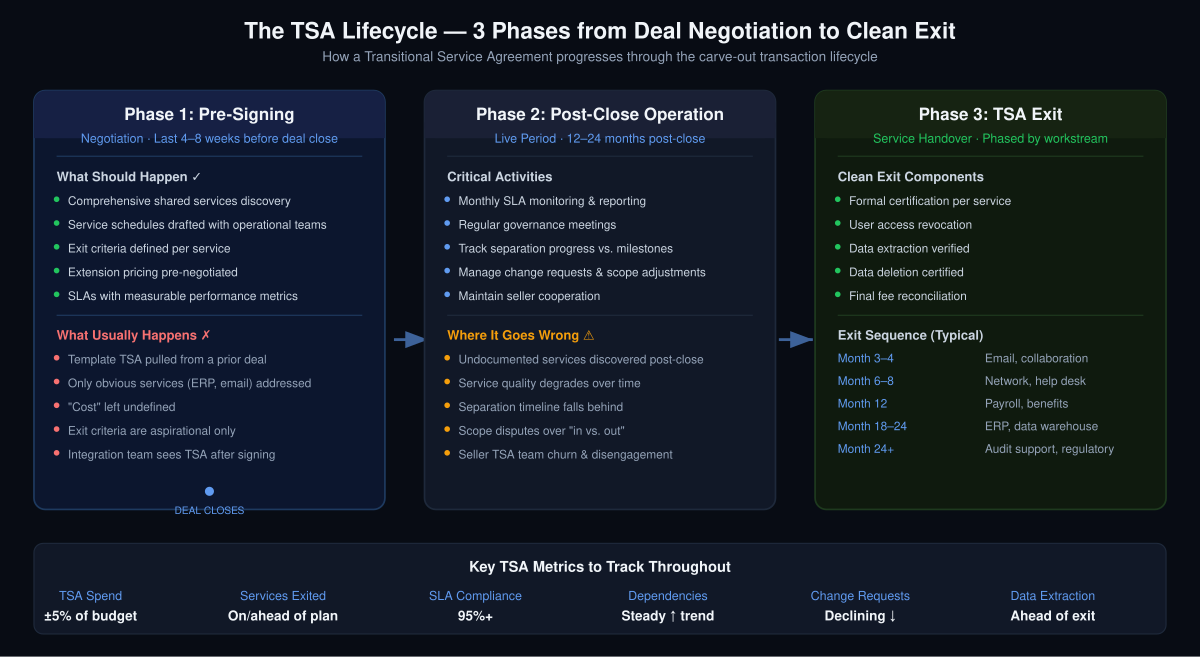
The TSA Lifecycle: Before, During, and After
Phase 1: Pre-Signing (Negotiation) — What Should Happen vs. What Usually Happens
This is where the TSA is defined, scoped, and priced. It happens during the deal negotiation period, typically in the final 4 to 8 weeks before signing.
What should be happening:
- Comprehensive shared services discovery — not just the obvious ones
- Service-level definition and pricing negotiation
- Exit criteria definition for each service
- Data access, deletion, and compliance provisions
- Penalty structures for service failures
What usually happens:
- A template TSA is pulled from a previous deal and lightly edited
- Only the most visible shared services (ERP, email, network) are addressed
- Pricing is set at cost-plus with vague definitions of “cost”
- Exit criteria are aspirational rather than operationalized
- The buyer’s integration team sees the TSA for the first time after signing
As Mayer Brown’s carve-out practice notes, “the TSA does not get the attention it should. With deal teams focused first and foremost on the M&A agreement, the TSA can easily become an afterthought, relegated to the final, frantic rush to signing.” This is the single most common and most expensive TSA mistake.
Phase 2: Post-Close Operation (Live Period)
From deal close until TSA exit, the seller provides services according to the agreement and the buyer executes the separation plan.
Critical activities during this phase:
- Monthly service-level monitoring and reporting
- Regular governance meetings — operational and steering committee level
- Tracking separation progress against TSA exit milestones
- Managing change requests and scope adjustments
- Maintaining seller relationship and cooperation
Where it goes wrong:
- The buyer discovers undocumented shared services post-close and needs amendments
- Service quality degrades because the seller’s teams have moved on to other priorities
- The buyer’s separation timeline falls behind, forcing extension negotiations from a weak position
- Disputes arise over what is “in scope” vs. “out of scope” for TSA fees
Phase 3: TSA Exit — What a Clean Exit Actually Looks Like
The handover from seller-provided services to the buyer’s standalone environment. This is the critical milestone that ends the TSA obligation.
TSA exit is not a single event. It is a phased process where individual services exit on different schedules. Email might exit at Month 3, network at Month 6, and ERP at Month 18. Each exit should have its own criteria, its own testing, and its own sign-off process. A clean exit involves:
- Formal certification that each service has been migrated or replaced
- User access revocation from seller systems
- Data extraction verification and deletion certification
- Final service reconciliation and fee settlement
- Contractual closeout and release of any TSA-related holdbacks
TSA Scope: What Should Be In (and Out)
Eight Standard TSA Workstreams with Duration Benchmarks
The scope of a TSA varies by deal, but most agreements cover some combination of these functional areas. Duration data draws from DealRoom’s 2026 benchmark of post-merger integration data and Deloitte/EY TSA practice notes.
| Service Category | Examples | Typical Exit Timeline |
|---|---|---|
| IT Infrastructure | Network, data centre, servers, cloud hosting | 6–12 months |
| Enterprise Applications | ERP, CRM, HRIS, procurement systems | 12–24 months |
| End-User Services | Email, collaboration tools, help desk, device management | 3–6 months |
| Finance & Accounting | General ledger, AP/AR, payroll, tax | 6–18 months |
| Human Resources | Payroll processing, benefits administration, recruiting systems | 6–12 months |
| Facilities | Office space, lab space, warehousing | 6–18 months |
| Procurement | Vendor contracts, purchasing accounts, supplier relationships | 3–12 months |
| Compliance & Legal | Regulatory reporting, licence management, IP | 6–18 months |
The Services That Are Almost Always Missed
The most expensive TSA amendments come from services that should have been included but were not. Based on analysis of 50+ carve-out transactions, these are the most common omissions:
- Shadow IT applications: SaaS tools that business units purchased without IT involvement. These can number in the dozens for mid-market companies and are almost never captured in standard diligence.
- Intercompany transaction processing: Custom-coded logic in the parent’s ERP that handles cross-entity billing, cost allocation, and transfer pricing. These are particularly challenging because they are embedded in the parent’s system logic, not standalone applications.
- Third-party software licences: Enterprise agreements held by the parent that cover the divested entity. When the carve-out separates, per-unit licence costs can increase 2 to 5x because the buyer loses the parent’s volume discount.
- Shared data centre or cloud environments: Physical or virtual infrastructure where the carve-out’s systems run alongside the parent’s. Separating these requires building parallel environments, not just migrating data.
- Vendor and supplier portals: Procurement accounts, supplier qualification records, and contract databases managed through the parent’s supplier management systems.
- Regulatory licences and certifications: Operating licences, quality certifications, and compliance attestations held at the parent level that the carve-out needs to obtain independently.
Services Better Left Out of the TSA
Not every shared service belongs in the TSA. Some are better addressed through standalone commercial agreements or handled entirely by the buyer from Day 1:
- Commodity services with fast setup times: Cloud-based email and collaboration (Microsoft 365, Google Workspace) can be provisioned in 2 to 4 weeks. There is rarely a reason to include these in a TSA beyond a short transition period.
- Services the buyer already provides: If the buyer has an existing HR platform, forcing the carve-out onto the seller’s system for 12 months just creates a double migration.
- Services with high seller dependency risk: If a service is critical but the seller has a single person who knows how to run it, and that person might leave, the buyer is better off migrating off that service as fast as possible rather than relying on the TSA.
- Services where the seller has a conflict of interest: If the seller competes with the carve-out in any market, they should not be providing services that involve customer data, pricing, or competitive strategy.
Why TSAs Fail: The 5 Most Common Failure Patterns
Most TSA problems are not caused by hostile sellers or incompetent buyers. They are caused by structural patterns that recur across deals with predictable regularity. Understanding these patterns is the first step to avoiding them.
1. The Last-Minute TSA — Negotiating in the Final 48 Hours
When the TSA is compressed into the final days before signing, service schedules are based on assumptions rather than operational diligence. The result: services are defined generically (“IT support”), critical dependencies are omitted because nobody had time to map them, and both parties sign something they barely understand. The amended TSAs that follow — and they almost always follow — are negotiated from a position of weakness because the deal has already closed.
The fix: Start TSA scoping during operational diligence, not during legal negotiations. The service schedules should be substantially drafted before the purchase agreement is signed. Include the people who will actually deliver and consume the services — not just legal counsel.
2. The Vague Scope — “IT Support” Is Not a Service Definition
A poorly drafted TSA schedule says the seller will provide “IT support” or “HR services.” A well-drafted one identifies each specific system, the personnel resources committed, hours of availability, geographic scope, and the standard to which the service will be performed. The difference between these two approaches is the difference between a working TSA and a litigation-ready ambiguity.
The fix: Define every service with the same precision you would use for an outsourcing contract. The service schedule — often the longest exhibit in the agreement — should be specific enough that a third party could determine whether a service is being delivered. If it does not specify systems, people, hours, and standards, it is not finished.
3. The Undocumented Dependency — Services Nobody Knew Existed
Every carve-out has hidden dependencies. The finance team has a spreadsheet that pulls data from the seller’s data warehouse via a macro nobody documented. The marketing team uses a shared Adobe licence managed by the corporate IT group. The R&D team’s test environment runs on a server rack that is part of the seller’s primary data centre lease. These dependencies surface post-close as operational emergencies, each requiring a TSA amendment and a price negotiation.
The fix: Invest in comprehensive shared services discovery before signing. Tools like CarveX map application landscapes, infrastructure dependencies, and data flows in 5 to 10 days, catching the shadow IT and embedded dependencies that standard due diligence misses.
4. The Degrading Service — Why Seller Quality Collapses Over Time
The seller’s best engineers are quietly reassigned to other projects within 60 days of close. The seller’s attention shifts to the next deal. The seller’s incentive to maintain quality diminishes with each passing month. Service level reports arrive late or stop arriving altogether. The seller’s TSA team changes frequently as key people leave.
A TSA without service levels is a TSA where quality will degrade — not because the seller is malicious, but because the seller’s operational priorities naturally shift to the retained business. This is predictable human behavior, not contractual bad faith.
The fix: Include specific, measurable service levels for each service category: uptime, response times, transaction processing times, data accuracy rates. Service levels should mirror what the business received pre-close — using the pre-close 12-month average as the baseline. Include reporting obligations with audit rights, and service credits (not token amounts) for persistent failures. LegalClarity’s analysis of SEC-filed TSAs shows service credits typically range from 2% to 10% of the monthly charge for the affected service.
5. The Phantom Exit — “Done” on Paper, Still Dependent in Practice
The buyer’s new ERP is technically live but the business continues to use the seller’s systems because the new environment lacks features, is slower, or has reliability issues. Formal exit happens on paper; operational exit never happens. The TSA keeps running, the meter keeps ticking, and the separation budget keeps blowing past its targets.
The fix: Define exit as a set of objective, verifiable conditions — not as a statement of intent. For ERP exit, this means: “(a) All general ledger, AP, AR, and fixed asset data for the most recent three fiscal years has been migrated; (b) the buyer has completed two consecutive successful month-end closes on the new ERP without reliance on seller data; (c) seller has certified deletion of buyer data from seller’s ERP environment.” Run dress rehearsals before exit: operate the new environment in parallel with the seller’s for a full business cycle and validate that every transaction type works.
TSA Pricing: What It Actually Costs

Four Pricing Models
TSA pricing typically follows one of these structures. Most mid-market agreements use cost-plus or a hybrid approach:
- Cost-Plus (Most Common): The seller charges the actual cost of providing the service plus an agreed markup, typically 5 to 15 percent. Transparent if the cost base is verified — but “cost” is often poorly defined and inconsistently calculated.
- Fixed Fee: A predetermined monthly or quarterly fee per service, regardless of actual cost. Predictable for the buyer but sellers protect themselves by pricing conservatively, so buyers often overpay.
- Declining Fee Schedule: Fees decrease over time as services are exited. Incentivises the buyer to exit quickly and reflects the declining value of services as the buyer builds independence.
- Tiered or Usage-Based: Fees tied to actual consumption: number of users, transaction volume, data storage. Aligns cost with usage but requires robust measurement and reporting.
TSA Cost Benchmarks by Deal Size
Based on analysis of 50+ mid-market carve-outs (£20M to £500M EV) completed between 2019 and 2025, supplemented by BCG’s 2024 M&A Integration Benchmarking data:
| Carve-Out Size (EV) | Typical Monthly TSA Cost | Typical Duration | Total TSA Cost Range |
|---|---|---|---|
| Under £50M | £30K–£80K/month | 9–18 months | £270K–£1.4M |
| £50M–£200M | £60K–£200K/month | 12–24 months | £720K–£4.8M |
| £200M–£500M | £150K–£500K/month | 18–24+ months | £2.7M–£12M+ |
IT typically represents 60 to 75 percent of the total TSA cost. For a £150M EV carve-out, that means IT TSA services alone cost approximately £70K to £150K per month during the transition period.
The 4 Hidden Costs and How to Negotiate Against Them
1. The “Change Request” Trap: Sellers often price the initial TSA attractively but charge premium rates for scope changes. If the buyer discovers new shared services after close — and they almost always do — each amendment comes with a negotiation and a price increase.
Protection: Negotiate a pre-agreed rate card for additional services. Include a mechanism for adding services at cost-plus with a capped markup during the TSA term.
2. The “Cost” Definition Gap: If the TSA says “cost” but does not define it, the seller interprets it in their favour. Does cost include overhead allocation? Depreciation? Management time? The seller’s internal IT chargeback model?
Protection: Define cost exhaustively: direct labour (named roles, not blended rates), infrastructure (specific servers, storage, licences), third-party pass-through (at cost, with invoices provided), and a defined overhead allocation percentage.
3. The Extension Premium: When the buyer cannot exit on time, the seller has leverage. Extension pricing is often 20 to 50 percent higher than the base TSA rate, and sellers may demand minimum extension periods of 6 months rather than month-to-month flexibility.
Protection: Negotiate extension pricing in the original TSA. Pre-agree on a rate — base rate plus 10 percent is a reasonable benchmark — and allow month-to-month extensions rather than block commitments.
4. The “Key Person” Risk: If the seller’s ability to provide a service depends on one or two specific individuals and those individuals leave, service quality collapses. The buyer still pays the TSA fee but gets diminished service.
Protection: Include key-person provisions. Require the seller to identify critical personnel, maintain backups, and include service credits or fee reductions if key-person departures degrade service quality.
TSA Negotiation: The Terms That Matter Most
Duration — The Single Most Important Term
TSA duration determines how much time the buyer has to separate, and it directly affects deal economics.
The standard range: 12 to 24 months is typical for mid-market carve-outs. Anything under 12 months is aggressive and only works for simple separations with minimal shared services. Anything over 24 months signals to the seller that the buyer is not serious about independence.
What to negotiate:
- Push for 18 to 24 months as the default, with the option to exit individual services earlier
- Negotiate service-specific durations. Email can exit in 3 months; ERP needs 18 months. Do not let the seller bundle everything under a single end date
- Include extension options, not requirements. Extensions at the buyer’s option — with pre-agreed pricing — are better than automatic renewals or seller-consent extensions
Service Levels — If You Can’t Measure It, You Won’t Get It
A TSA without service levels is a TSA where quality will degrade. The seller’s best people move on; the seller’s attention shifts to the next deal.
What to negotiate:
- Specific, measurable service levels for each service category: uptime, response times, transaction processing times, data accuracy rates
- Service levels should mirror what the business received pre-close, using the 12-month pre-close average as the baseline
- Include reporting obligations: monthly service level reports with the right for the buyer to audit
- Include service credits or fee reductions for persistent failures — credits should be meaningful (2% to 10% of monthly service charge) and automatically applied
Exit Criteria — Why “ERP Migration Complete” Is Not an Exit Criterion
The most common TSA failure mode is vague exit criteria. “ERP services will be considered exited when the buyer has migrated to their target ERP” is not an exit criterion — it is a statement of intent. Does migration mean all data? Most data? Does it require a successful month-end close? What if the new ERP is live but parallel running?
What to negotiate:
- Define exit for each service as a set of objective, verifiable conditions
- Example for ERP exit: “(a) All GL, AP, AR, and fixed asset data for the most recent three fiscal years has been migrated to the buyer’s ERP; (b) the buyer has completed two consecutive successful month-end closes on the new ERP without reliance on seller data; (c) seller has certified deletion of buyer data from seller’s ERP environment”
- Include a dispute resolution mechanism for exit certification disagreements
Data Access and Deletion — The Regulatory Dimension
TSA data provisions are frequently under-negotiated despite significant regulatory implications under GDPR, CCPA, and similar frameworks.
What to negotiate:
- The buyer owns all data generated by the divested business — both historical and during the TSA period
- The buyer has the right to extract data in a standard, usable format at any time during the TSA, not just at exit
- Upon exit of each service, the seller must certify in writing that all buyer data has been deleted from seller systems, including backups
- The seller must provide reasonable assistance with data extraction, migration, and validation at no additional cost
Termination Rights — What Happens When the Seller Fails
Without clear termination rights, the buyer is stuck paying for substandard services with no recourse.
What to negotiate:
- The buyer has the right to terminate individual services early without penalty if the seller materially fails to meet service levels
- The buyer has the right to terminate any service early for convenience, with reasonable notice (e.g., 60 days)
- If the seller fails to perform and the buyer terminates a service, the seller must refund prepaid fees and provide reasonable transition assistance
Governance — The Structure That Keeps TSAs on Track
TSAs need active management, not passive monitoring. The governance structure should be defined in the agreement itself.
What to negotiate:
- Monthly operational review meetings with named representatives from both parties
- Quarterly steering committee meetings with senior-level attendance
- A formal change request process with defined response times and pre-agreed pricing parameters
- Escalation paths for disputes with time-bound resolution requirements
TSA Exit: How to Get Out Clean
Why TSA Exits Run Over — The 5 Root Causes
Despite the best intentions, TSA exits frequently run over schedule. Based on our analysis of 50+ transactions, these are the five root causes:
- Undocumented dependencies: The buyer discovers shared systems, data flows, or processes that nobody identified during diligence. Each discovery creates a new separation workstream that was not in the plan.
- Underestimated data complexity: Migrating data from the seller’s environment takes longer than expected because of data quality issues, format incompatibilities, or regulatory retention requirements.
- Parallel running drags on: The buyer’s new systems are technically live but the business continues to use the seller’s because the new environment lacks features, is slower, or has reliability issues.
- ERP migration delays: ERP migration is consistently the longest pole in the TSA exit tent. A 12-month plan is optimistic. An 18-month plan is realistic. A 24-month plan is prudent.
- Seller disengagement: The seller’s teams lose interest as the TSA ages. Knowledge transfer stalls. Key people leave. Support becomes reactive rather than proactive.
The TSA Exit Playbook — 6 Steps to On-Time Exit
- Start exit planning on Day 1. Do not wait until Month 6 to begin planning Month 12 exits. The exit plan should be fully defined, resourced, and tracked from the first week post-close.
- Sequence exits by risk, not convenience. Exit low-risk, commodity services first (email, collaboration, help desk). These build organizational confidence and free up resources for harder exits (ERP, data warehouse, custom applications).
- Run dress rehearsals. Before exiting any critical service, operate the new environment in parallel with the seller’s for a full business cycle. Validate that every transaction type, every report, and every integration works.
- Track dependencies aggressively. Maintain a live dependency map showing what services, systems, and processes depend on each TSA service. Update it monthly. When a dependency is resolved, test that the resolution is real.
- Negotiate exit supportinto the original TSA. The seller should be obligated to provide reasonable transition assistance: knowledge transfer sessions, documentation handover, technical support during cutover, and post-exit support for a brief stabilization period (e.g., 30 days).
- Build a TSA exit war room. In the final 60 days before each major service exit, stand up a dedicated team with representation from the buyer’s IT, business operations, and the seller’s TSA support team. Daily standups. Issues resolved within 24 hours. No exceptions.
What to Do When You’re Going to Miss the Date
Extensions happen. Most carve-outs need at least one. The key is managing them from a position of strength rather than desperation:
- Raise the flag early. If you know at Month 9 that the Month 12 ERP exit is not happening, tell the seller at Month 9, not Month 11.5. This preserves trust and gives both parties time to plan.
- Come with a credible revised plan. Do not ask for an open-ended extension. Present a specific new exit date with a detailed plan showing what changed, what is being done differently, and why the new date is achievable.
- Negotiate from the original TSA terms. If you pre-negotiated extension pricing, use it. If not, point to the TSA’s existing pricing as the baseline and push back on premium extension fees.
- Consider partial exits. If the ERP migration is delayed but the CRM, HRIS, and procurement systems are ready, exit those services on schedule. Partial exits reduce TSA fees, demonstrate progress, and maintain momentum.
TSA Metrics: What to Track and Report
The TSA Health Dashboard — 7 KPIs
Every TSA should have a dashboard tracking these metrics, reviewed monthly:
| Metric | What It Measures | Target |
|---|---|---|
| TSA spend vs. budget | Monthly and cumulative TSA fees vs. plan | Within 5% of budget |
| Services exited | Number of services formally exited vs. plan | On or ahead of schedule |
| Exit date forecast | Projected exit date for each remaining service | Within 30 days of original plan |
| Dependencies resolved | Percentage of known shared dependencies resolved | Steady upward trend |
| Service level compliance | Seller’s performance against agreed SLAs | 95%+ compliance |
| Change requests | Number and cost of TSA amendments | Declining trend |
| Data extraction progress | Percentage of target data extracted from seller systems | Ahead of exit schedule |
Leading Indicators of TSA Trouble — The 6 Warning Signs
Watch for these early warning signs. When three or more appear simultaneously, the TSA is at risk — escalate to senior leadership on both sides:
- Service level reports arrive late or stop arriving altogether
- Seller’s TSA team changes frequently or key people leave
- Seller pushes back on routine data access requests
- Seller starts billing for items that were previously included
- Business users report that “the old system was better” or refuse to adopt new systems
- The monthly TSA governance meeting becomes a status update rather than a problem-solving session
TSA Case Examples: How It Plays Out in Practice
The following case examples are composites drawn from multiple real transactions. They do not represent any single identifiable deal but reflect patterns observed across 50+ mid-market carve-outs.
Case 1: The Standard Mid-Market Carve-Out (£150M EV Manufacturing)
A £150M EV manufacturing carve-out from a large industrial conglomerate. The target has 800 employees across three countries.
TSA scope: IT (ERP, network, email, help desk), finance (AP/AR, payroll, tax), HR (benefits administration), facilities (shared office space at two locations).
TSA duration: 18 months, with the option to exit individual services earlier.
Pricing: Cost-plus 10%. Monthly cost approximately £120K, declining as services exit.
Outcome: Email and collaboration exited at Month 4. Network and help desk exited at Month 8. Payroll and benefits exited at Month 12. ERP exit planned for Month 18 but extended to Month 22 due to data migration complexity. Total TSA cost: £2.3M (within 5% of budget). The key success factor was an aggressive early exit schedule that built momentum and freed up resources for the harder migrations.
Case 2: The Complex Multi-Geography Carve-Out (£400M EV Financial Services)
A £400M EV financial services carve-out operating across five countries with different regulatory regimes, different ERP instances, and different banking relationships in each jurisdiction.
TSA scope: IT (multiple ERPs, trading systems, market data feeds, compliance systems), finance (multi-currency, multi-entity), HR (five-country payroll), legal and compliance (regulatory licences in each jurisdiction).
TSA duration: 24 months, with potential extensions for specific regulated services.
Pricing: Hybrid — fixed fee for IT infrastructure, cost-plus for applications and business services. Monthly cost approximately £350K.
Outcome: Significant delays. Country-by-country ERP separation proved far more complex than anticipated. Three of five countries exited on schedule. Two required 6-month extensions. Regulatory licence transfers added unplanned complexity. Total TSA cost: £9.2M (30% over budget). The lesson: multi-geography carve-outs need country-level TSA planning, not consolidated planning. Each jurisdiction is effectively its own mini-carve-out.
Case 3: The Simple Service-Only TSA (£40M EV Bolt-On)
A £40M EV bolt-on acquisition where the buyer had a mature IT and operations platform and only needed limited TSA services.
TSA scope: Limited to payroll processing (3 months), benefits administration (6 months), and legacy data access (12 months read-only).
Pricing: Fixed fee, £15K/month declining to £5K/month.
Outcome: All services exited on or ahead of schedule. Total TSA cost: £120K. The buyer’s existing platform absorbed the target quickly. This is the ideal TSA scenario, but it is only achievable when the target’s shared dependencies are minimal and the buyer has a proven integration capability.
How Technology Enables Faster TSA Exit
The speed and quality of IT separation directly determines TSA duration. Technology platforms that map dependencies, sequence exits, and track progress in real time are not optional for complex carve-outs — they are the difference between exiting on schedule and burning millions in extension costs.
At AssetMax, we built CarveX to address the hardest part of any carve-out: the technology separation that determines whether you exit the TSA on time or burn cash on extensions.
Pre-Signing TSA Intelligence
- Shared services discovery: CarveX maps every shared application, infrastructure component, data flow, and vendor dependency, typically in 5 to 10 days. This catches the shadow IT and embedded dependencies that standard due diligence misses — giving deal teams the leverage to negotiate a complete TSA scope before signing.
- Cost benchmarking: Using data from 200+ carve-out transactions, CarveX provides TSA cost estimates grounded in real benchmarks. Buyers can validate the seller’s proposed pricing against comparable separations.
Post-Close TSA Execution
- Dependency mapping and tracking: CarveX models the network of interdependencies between TSA services, internal systems, and business processes. When something changes — a delayed migration, a new shared dependency discovered — the model updates to show the impact on exit timelines.
- Exit sequencing engine: CarveX determines the optimal sequence for TSA service exits to minimize business disruption, reduce TSA duration, and manage risk. The sequencing model accounts for real-world constraints that generic project plans overlook.
- TSA exit dashboard: Real-time visibility into separation progress, dependency resolution, and exit date forecasts — shared between buyer, seller, and integration teams to maintain alignment and accountability.
For deal teams, the impact is measurable: CarveX clients exit TSAs 30 to 50 percent faster than industry averages, with 15 to 25 percent lower total TSA costs — because dependencies are identified before they become surprises, and exit plans are grounded in operational reality rather than deal-team optimism.
For PE firms conducting due diligence on carve-out targets, Diligize complements TSA planning by providing AI-powered technology due diligence that identifies integration risks, separation complexity, and TSA dependencies during the pre-acquisition phase.
Key Takeaways: 10 Rules for TSA Success
- Negotiate the TSA like it is part of the purchase price. Every dollar in TSA fees and every month of delay reduces the deal’s effective return.
- Invest in shared services discovery before signing. The most expensive TSA amendments are the ones that add services nobody identified during diligence.
- Price the TSA properly. Cost-plus is standard, but only if “cost” is defined exhaustively. Pre-negotiate extension pricing, change request rates, and rate cards for additional services.
- Define exit criteria with precision. Every service should have objective, measurable exit conditions. “ERP migration complete” is not an exit criterion.
- Start exit planning on Day 1. Every week of delay in starting separation work is a week you will have to negotiate back at extension pricing.
- Sequence exits strategically. Exit commodity services fast to build momentum. Save the hard exits for when the team has gained experience.
- Govern the TSA actively. Monthly operational reviews, quarterly steering committees, and live dashboards are not optional.
- Prepare for extensions. Most carve-outs need at least one. Negotiate the extension framework in the original TSA — not from a position of weakness when the deadline approaches.
- Manage the seller relationship. Treat the TSA as a partnership, not a confrontation — but maintain leverage through clear contractual rights.
- Technology enables TSA exit. The speed and quality of IT separation directly determines TSA duration. Invest in discovery, planning, and execution tools that give you real visibility.
Frequently Asked Questions
What is a TSA in M&A?
A Transitional Service Agreement (TSA) is a contract between the buyer and seller of a divested business unit where the seller agrees to continue providing specific operational services — IT, HR, finance, facilities — for a defined period after the deal closes. TSAs are essential in carve-out transactions where the target business does not have standalone infrastructure and relies on the seller’s shared services to operate. Without a TSA, a carve-out business would be unable to function from Day 1: no email, no payroll, no customer orders, no financial reporting.
How long does a typical TSA last?
TSA durations typically range from 12 to 24 months for mid-market carve-outs, though specific services within a TSA exit on different schedules. IT infrastructure and enterprise applications (ERP) typically require the longest runways at 12 to 24 months, while end-user services like email and collaboration can exit in 3 to 6 months. Complex carve-outs, cross-border deals, and heavily regulated industries tend toward the longer end of the range. Short TSAs under 12 months are achievable only for simple separations with minimal shared dependencies.
What is the difference between a TSA and a Transition Services Agreement?
There is no substantive difference. “Transitional Service Agreement” and “Transition Services Agreement” refer to the same type of contract and are used interchangeably in practice. “Transitional Service Agreement” is more common in European deals, while “Transition Services Agreement” is more common in US deals. Both acronyms resolve to TSA. A third, less common usage — “Technical Service Agreement” — refers to ongoing maintenance contracts in industrial/manufacturing contexts and is unrelated to M&A.
How much does a TSA cost?
TSA costs vary by deal size and complexity. For a carve-out under £50M EV, expect £30K–£80K per month. For £50M–£200M EV deals, £60K–£200K per month. For £200M–£500M EV, £150K–£500K per month. IT services typically represent 60–75% of the total. Total TSA costs over the life of the agreement range from approximately £270K for simple deals to over £12M for complex multi-geography carve-outs.
What services are typically covered in a TSA?
TSAs typically cover eight workstreams: IT infrastructure (networks, data centres, cloud hosting), enterprise applications (ERP, CRM, HRIS), end-user services (email, help desk), finance and accounting (GL, AP/AR, payroll), human resources (benefits, recruiting systems), facilities (office space, warehousing), procurement (vendor contracts, purchasing accounts), and compliance/legal (regulatory reporting, licence management). The most commonly missed services are shadow IT applications, intercompany transaction processing, and shared software licences.
What is a reverse TSA?
A reverse TSA is an agreement where the buyer provides services back to the seller after close. This occurs when key personnel, technology, or capabilities that the seller’s retained business depends on are part of the divested entity. For example, if the carve-out includes a shared data centre that also serves the seller’s remaining operations, the buyer may need to provide data centre services to the seller through a reverse TSA while the seller builds alternative infrastructure. Reverse TSAs should be scoped and priced with the same rigor as forward TSAs but are frequently underestimated or entirely overlooked during deal negotiations.
Can a TSA be terminated early?
Yes, if the TSA includes appropriate termination provisions. Buyers should negotiate the right to terminate individual services early without penalty if the seller materially fails to meet agreed service levels, and the right to terminate any service early for convenience with reasonable notice (typically 60 days). If the seller fails to perform and the buyer terminates a service, the TSA should require the seller to refund prepaid fees for that service and provide reasonable transition assistance. Without these provisions, buyers are locked into paying for substandard services with no exit.
What happens if the buyer can’t exit the TSA on time?
If the buyer cannot meet TSA exit deadlines, an extension is required. How painful this is depends on what was negotiated in the original TSA. Without pre-negotiated extension terms, sellers typically charge a 20–50% premium over the base rate and may demand minimum extension blocks of 6 months rather than month-to-month flexibility. The best practice is to negotiate extension pricing — typically base rate plus 10% — and month-to-month extension flexibility in the original TSA, then raise the flag early with a credible revised plan rather than asking at the last minute.
Who pays for TSA services?
The buyer pays for TSA services, typically through monthly invoicing in arrears with payment due within 30 days. Pricing is most commonly structured as cost-plus (seller’s actual cost plus a 5–15% markup), though fixed-fee, declining-fee, and usage-based models are also used. The buyer should negotiate for transparent, line-item billing that ties every charge to the schedule of services. Late payments can trigger penalty interest — SEC-filed TSAs have included rates as high as 2% monthly on overdue amounts — so payment discipline matters.
What is the difference between a TSA and an SPA?
A Share Purchase Agreement (SPA) or Asset Purchase Agreement is the primary transaction document that defines the terms of the sale itself — purchase price, representations and warranties, indemnification, and closing conditions. A TSA is a separate, ancillary agreement that governs post-closing operational services. While the SPA determines what is being bought and at what price, the TSA determines how the business will actually operate after the deal closes until the buyer achieves standalone independence. Both are critical, but the TSA is frequently under-negotiated relative to its financial impact. The TSA’s total cost over 18–24 months can be material enough to meaningfully affect the deal’s effective purchase price.
About This Guide
This guide was produced by the AssetMax research team, drawing on practitioner experience across 200+ carve-out transactions combined with analysis of published research from BCG, Deloitte, Bain & Company, and DealRoom’s 2026 post-merger integration benchmarking data. The cost benchmarks and timelines are based on analysis of 50+ mid-market carve-out transactions (£20M to £500M EV) completed between 2019 and 2025. Individual deal outcomes vary significantly based on deal structure, geography, technology complexity, and team capability. The case examples are composites drawn from multiple transactions and do not represent any single identifiable deal.
To learn more about how AssetMax supports TSA planning, carve-out execution, and post-merger IT integration, visit assetmax.ai/carvex or contact our team.
References
- Boston Consulting Group. “M&A in the Age of Technology: 2024 Integration Benchmarking Report.” BCG, 2024.
- Deloitte. “The Art of Transition Service Agreement Negotiations.” Deloitte Consulting LLP, 2025.
- Bain & Company. “M&A Integration Best Practices: Resourcing Models That Work.” Bain & Company, 2023.
- DealRoom. “Transition Service Agreement: Definition, How it Works (+ Template).” DealRoom M&A Benchmark Data, 2026.
- Mayer Brown. “Negotiating Transition Services Agreements in Carve-Out M&A Deals.” Mayer Brown LLP, 2024.
- McKinsey & Company. “The Value of Post-Merger Integration.” McKinsey M&A Research Programme, 2020–2024.
- LegalClarity. “What Is a TSA in M&A? Transition Service Agreements.” May 2026.