
Most M&A deals fail for reasons that were visible during due diligence — hidden in the technology stack. For special situations investors, where speed is everything and targets are often distressed, the risk of missing these signals is even higher. Here’s how to find the technology risks that kill returns, before they find you.
In 2026, technology due diligence has pulled decisively ahead of every other domain. According to SRS Acquiom’s latest M&A study, 47% of dealmakers now rank technology as their top due diligence priority, and 51% say it is the single most burdensome element of the entire review process. The reason is simple: when technology fails, deals fail.
For special situations investors — those operating in distressed M&A, carve-outs, and turnaround scenarios — the stakes are even higher. You’re buying companies under duress. Their technology infrastructure is often years behind. Their security posture may be non-existent. Their technical debt may be so severe that the cost of remediation exceeds the value of the deal itself.
This guide provides the framework, checklist, and cost benchmarks that special situations investors need to conduct technology due diligence that actually protects returns — not just checks a box.
Why Technology Due Diligence Makes or Breaks Distressed Deals
The Hidden Cost of Skipping Tech DD
The numbers are brutal. Research from Human Renaissance found that 74% of target company codebases contain high-risk vulnerabilities that could compromise operations post-acquisition. TransJovan Capital’s analysis shows that 53% of acquirers discover critical cybersecurity issues only after closing, and 70% of deals face operational disruption from unaddressed technical debt.
The financial impact is equally stark. IBM’s 2024 Cost of a Data Breach report pegged the global average breach cost at $4.88 million. For a mid-market acquisition — exactly the territory where special situations investors operate — a single post-close cybersecurity incident can wipe out the entire value-creation plan.
Consider Verizon’s acquisition of Yahoo. Originally valued at $4.83 billion, the deal price was reduced by $350 million after due diligence uncovered massive unreported data breaches. That’s a 7.2% price reduction driven entirely by technology risk — discovered during diligence, not after.
But here’s the uncomfortable truth: most special situations investors still treat technology due diligence as an afterthought. Financial DD gets top billing. Legal DD gets the second chair. Technology — the infrastructure that actually runs the business — gets a cursory IT checklist, if anything at all.
What Makes Distressed Targets Uniquely Dangerous
Distressed targets aren’t just standard acquisitions with lower price tags. They carry specific technology risks that don’t appear on standard due diligence checklists:
- Deferred maintenance as survival strategy. When a company is fighting for survival, IT budgets are the first to be cut. Software licenses go unrenewed. Security patches are skipped. Hardware reaches end-of-life and stays there. By the time you acquire the target, the technology stack may be held together by institutional knowledge and hope.
- Key-person dependencies in IT. In distressed companies, critical technical knowledge often lives in one or two people. If those people leave during or after the transaction — and they often do — you inherit a black box. A BCG study of carve-out transactions found that key-person risk in IT was the single most underestimated factor in post-close integration failures.
- Shadow IT and undocumented systems. Distressed companies often build workarounds to keep the lights on. Spreadsheets become de facto ERP systems. Unapproved cloud tools proliferate. When you conduct technology due diligence, what’s documented is rarely what’s actually running.
- Vendor relationships in disrepair. Unpaid bills, lapsed support contracts, and toxic vendor relationships can prevent you from getting critical systems back on stable footing post-close. You may be buying into a situation where essential software vendors refuse to work with the company.
- Regulatory compliance gaps. Distressed companies often let compliance slide. GDPR violations, lapsed SOC 2 certifications, and unaddressed audit findings can create immediate legal exposure the moment you take ownership.
The Three Deals That Failed — And What Technology DD Would Have Found
Case 1: The Hidden ERP Migration. A PE firm acquired a manufacturing company out of a distressed corporate divestiture at what looked like a bargain price. Within 90 days of closing, they discovered the target had been running on the parent company’s SAP instance under a TSA. Building a standalone ERP would cost $2.4 million and take 14 months — a cost not factored into the deal model. The deal’s projected 22% IRR became 4%.
Case 2: The Ransomware Time Bomb. A special situations fund acquired a logistics company with aging IT infrastructure. Six weeks post-close, ransomware encrypted the company’s entire fleet management system. The attackers had been inside the network for eight months prior to the acquisition. The remediation cost: $1.8 million in recovery, plus $600,000 in lost revenue during the 3-week outage. A proper cybersecurity assessment during diligence would have surfaced the vulnerability.
Case 3: The Licensing Liability. An investor acquired a software-enabled services business. During diligence, the seller represented that all software was properly licensed. Post-close, an audit by a major enterprise software vendor revealed $900,000 in unlicensed usage — spanning three years of compliance gaps the seller hadn’t disclosed. The investor was on the hook.
The Technology Due Diligence Framework for Special Situations
Standard technology due diligence is designed for stable, well-documented targets with cooperative sellers. Special situations require a different approach — one that accounts for limited information, compressed timelines, and sellers who may not know (or may not disclose) what’s actually running in their technology environment.
We recommend a three-phase framework:
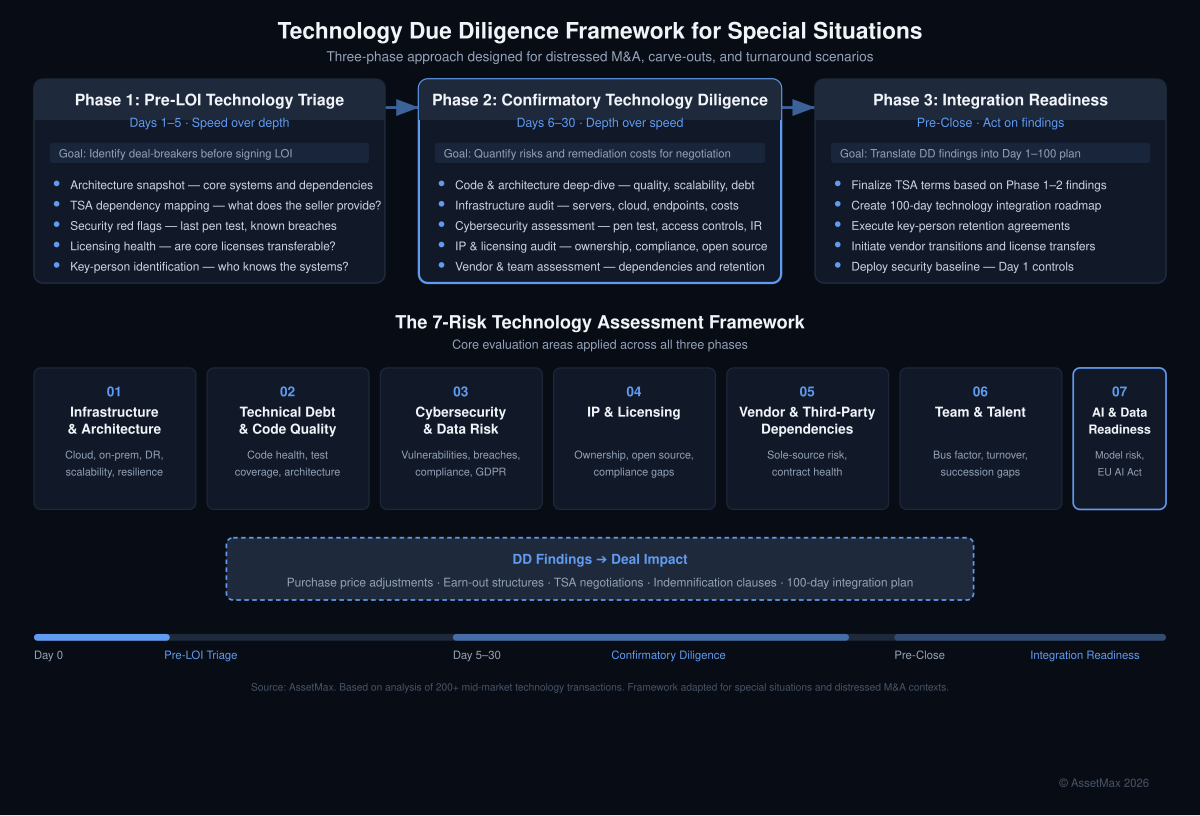
Phase 1: Pre-LOI Technology Triage (Days 1–5)
Before you sign the LOI, you need a rapid technology assessment that identifies deal-breakers. This phase is not about deep analysis — it’s about surfacing risks that would cause you to walk away or materially adjust your bid.
- Architecture snapshot: What are the core systems? ERP, CRM, custom-built software, cloud infrastructure. Can the business operate independently from the parent/seller on Day 1?
- TSA dependency mapping: What technology services does the seller currently provide? How long will transitional services be needed, and at what cost?
- Security red flags: When was the last penetration test? Are there any known breaches or incidents? What compliance certifications are active?
- Licensing health check: Are core software licenses current, transferable, and sufficient for standalone operations?
- Key person identification: Who knows how the systems actually work? Are they staying?
Output: A one-page technology risk memo with a go/no-go recommendation and estimated remediation budget range. If the target is a carve-out, tools like CarveX can accelerate TSA dependency analysis and IT separation planning in this phase.
Phase 2: Confirmatory Technology Diligence (Days 6–30)
After the LOI, you have the access and time to validate your Phase 1 findings and quantify remediation costs in detail. This is where structured technology due diligence — powered by tools like Diligize for automated technology assessment — transforms guesswork into negotiation leverage.
- Code and architecture deep-dive: Review codebase quality, technical debt levels, scalability constraints, and architectural documentation.
- Infrastructure audit: Map all servers, networks, cloud services, endpoints. Identify end-of-life hardware, unsupported operating systems, and cloud cost inefficiencies.
- Cybersecurity assessment: Conduct or commission a penetration test. Review access controls, incident response plans, and security monitoring capabilities.
- IP and licensing audit: Verify ownership of all intellectual property, including code written by contractors. Audit all software licenses for compliance and transferability.
- Data architecture review: Understand data flows, storage practices, backup procedures, and any regulatory exposure (GDPR, CCPA, industry-specific regulations).
- Team and vendor assessment: Evaluate the IT team’s capabilities, key-person risk, and the health of vendor relationships.
Output: A detailed technology due diligence report with quantified risks, remediation cost estimates, and a post-close technology integration roadmap.
Phase 3: Integration Readiness Assessment (Pre-Close)
The period between signing and closing is when you translate diligence findings into an actionable Day 1–100 plan. This phase is critical — and it’s where most deals fall apart.
- TSA negotiation finalization: Based on Phase 1-2 findings, finalize the scope, duration, and cost of transitional service agreements.
- Integration roadmap: Create a detailed 100-day technology integration plan with clear milestones, owners, and budget.
- Key person retention: Execute retention agreements for critical IT personnel. If they’re leaving, document their knowledge before they go.
- Vendor transition: Initiate license transfers, contract novations, and new vendor relationships where needed.
- Security baseline: Prepare to deploy your security stack — endpoint protection, network monitoring, access management — on Day 1.
What to Look For: The 7-Risk Technology Assessment
Technology due diligence isn’t one big question — it’s seven distinct risk assessments, each with its own methodology, red flags, and cost implications.
1. Infrastructure & Architecture Risk
Can the technology foundation support the business — today and under your growth plan? In distressed targets, infrastructure is often the most neglected asset class.
- Red flags: End-of-life servers, unsupported operating systems (Windows Server 2012, anyone?), single points of failure, no disaster recovery plan, no backup testing, cloud environments with runaway costs
- What to ask: When was the last infrastructure refresh? Is there a documented architecture diagram? What’s the patching cadence? How often are backups tested?
- Cost to watch: Infrastructure remediation typically ranges from $150,000 to $1.2 million for mid-market targets, depending on the extent of hardware refresh, cloud migration, and resilience investment needed
2. Technical Debt & Code Quality Risk
Technical debt is the silent killer of post-acquisition returns. It’s the accumulated cost of shortcuts, deferred refactoring, and outdated technology choices that makes every future change slower and more expensive.
- Red flags: No automated tests, monolithic architecture that can’t scale, dependency on deprecated frameworks, zero documentation, deployment processes that take days, “nobody touches that module”
- What to ask: What’s the test coverage? How long does a production deployment take? What’s the oldest technology stack component still in use? Has anyone tried to modernize — and failed?
- Cost to watch: Technical debt remediation for a typical mid-market acquisition ranges from $200,000 to $2 million+, depending on codebase size, architecture complexity, and whether refactoring or rewriting is required
3. Cybersecurity & Data Risk
For special situations investors, cybersecurity is the risk most likely to destroy value overnight. Distressed companies often have minimal security investment — and maximal exposure.
- Red flags: No penetration testing history, unpatched critical vulnerabilities, no MFA on critical systems, no incident response plan, history of breaches or ransomware, no security monitoring (SIEM), compliance certifications lapsed or never obtained
- What to ask: When was the last security assessment — internal or external? Is there a CISO or equivalent? What security tools are deployed? Has the company ever experienced a data breach?
- Cost to watch: Security hardening for a target with known gaps: $100,000–$500,000 for basic controls (MFA, EDR, patching, SIEM). Full security program build-out can exceed $1 million. A single ransomware incident can cost $4 million+.
For deeper cybersecurity assessment, Praetorian provides AI-powered security scanning and risk quantification specifically designed for M&A due diligence contexts.
4. IP & Licensing Risk
You need to confirm that the target actually owns what you think you’re buying — and that it’s not sitting on a licensing time bomb.
- Red flags: Contractor-developed code without IP assignment, open-source components with restrictive licenses (GPL, AGPL), unlicensed commercial software, lapsed maintenance agreements, patent disputes or threats
- What to ask: Who wrote the software? Are there IP assignment agreements for all contractors? What open-source components are in use? Are all commercial licenses current and transferable?
- Cost to watch: Open-source license remediation: $50,000–$300,000. Commercial licensing gaps: highly variable — one enterprise software audit can uncover $500,000+ in unpaid license fees. IP ownership disputes can kill deals entirely.
5. Vendor & Third-Party Dependency Risk
Every external dependency is a risk vector. In distressed situations, vendor relationships may be strained, contracts may be non-transferable, and critical services may be at risk of termination.
- Red flags: Single-source vendors for critical infrastructure, unpaid vendor invoices, non-transferable contracts, vendors requiring renegotiation post-acquisition, dependencies on seller’s vendor agreements (common in carve-outs)
- What to ask: Is there a complete vendor inventory? Which vendors are critical (the business stops if they stop)? Are contracts transferable? Are there outstanding bills?
- Cost to watch: Vendor transition and renegotiation: $50,000–$250,000 in professional fees and contract work. The bigger risk is operational — vendor transitions can take 3–6 months and cause service disruption.
6. Team & Talent Risk
Technology doesn’t run itself. The people who built and maintain the systems are often more valuable than the systems themselves — and in distressed companies, they’re often looking for the exit.
- Red flags: One person holds all critical knowledge (the “bus factor” = 1), above-market IT turnover, no documentation of key processes, IT team understaffed relative to industry benchmarks, leadership vacuum in technology function
- What to ask: Who are the top 3 people the business can’t afford to lose in IT? What’s the turnover rate in the technology team? Is there succession planning? Are salaries competitive?
- Cost to watch: Replacing critical technical talent: 150–200% of annual salary per role (recruiting, onboarding, productivity ramp). Knowledge transfer from departing staff: $30,000–$100,000 in consulting costs.
7. AI & Data Readiness Risk
In 2026, every acquisition is an AI acquisition — whether you realize it or not. The target’s data architecture, AI capabilities, and AI-related liabilities directly impact future value creation.
- Red flags: AI features built on unlicensed training data, dependence on third-party AI APIs with no fallback, no AI governance framework, data not structured for AI/ML use, customer data used for AI training without consent
- What to ask: Does the company use AI in its products or operations? If so, where did the training data come from? Are there AI-specific regulatory exposures (EU AI Act, etc.)? Is the data architecture ready for AI-driven value creation?
- Cost to watch: AI compliance remediation: $100,000–$500,000 for governance frameworks, data consent programs, and model documentation. AI infrastructure build-out for data-lagged targets: $200,000–$1 million.
Technology Due Diligence Checklist for Distressed M&A
Use this checklist as your technology due diligence starting point. Adapt the depth based on deal size, target complexity, and investment thesis.
Pre-Diligence Setup
- Assemble technology DD team (internal + external advisors)
- Define scope based on investment thesis — what matters most?
- Prepare data room request list with technology-specific requirements
- Schedule management interviews with CTO/IT leadership
- Identify TSA requirements if this is a carve-out
- Set up secure document sharing and analysis environment
Infrastructure Deep-Dive
- Inventory all servers (physical, virtual, cloud), including age and support status
- Document cloud provider relationships, spend, and architecture (AWS, Azure, GCP)
- Review network topology and identify single points of failure
- Test disaster recovery plan — has it ever actually been executed?
- Audit backup frequency, retention, and restore testing history
- Evaluate monitoring and alerting maturity
- Assess end-user device fleet (age, patch status, management)
- Map all integration points with parent/seller systems (carve-out critical)
Application & Software Assessment
- Catalog all business applications (ERP, CRM, HRIS, custom apps)
- For custom software: review architecture, code quality, test coverage, deployment process
- Identify end-of-life or unsupported software platforms
- Document all integrations between applications
- Assess scalability of core applications under your growth plan
- Review software development lifecycle maturity (DORA metrics: deployment frequency, lead time, change failure rate)
- Map technical debt by component and estimate remediation cost
Security & Compliance Review
- Request last 2 years of penetration test results
- Review vulnerability management program and patching cadence
- Audit access controls: who has admin? Is MFA enforced? How are offboarding processes handled?
- Assess incident response capability — run a tabletop exercise if possible
- Review compliance certifications (SOC 2, ISO 27001, PCI DSS, HIPAA)
- Check for regulatory exposure (GDPR, CCPA, EU AI Act, sector-specific)
- Document any known security incidents or breaches in the last 3 years
- Evaluate third-party risk management program
Cost & Remediation Estimate
- Build a prioritized remediation budget with high/medium/low estimates
- Separate Day 1 mandatory spending from Year 1 discretionary investment
- Include TSA costs if applicable (transitional service fees, separation project management)
- Factor in key-person retention bonuses and replacement costs
- Estimate vendor transition costs (license transfers, contract novations)
- Build contingency: add 25–40% to technology remediation estimates for distressed targets (unknowns are higher)
What Technology Remediation Actually Costs
One of the biggest gaps in technology due diligence — and one of the most costly — is the failure to translate findings into real dollar estimates. Based on our analysis of 200+ mid-market transactions, here are the cost benchmarks investors should use:
| Remediation Area | Low Estimate | High Estimate | Typical Timeline |
|---|---|---|---|
| Infrastructure modernization (servers, network, cloud migration) | $150,000 | $1,200,000 | 6–18 months |
| Security hardening (MFA, EDR, SIEM, patching) | $100,000 | $500,000 | 3–9 months |
| Technical debt remediation (refactoring, rewriting) | $200,000 | $2,000,000+ | 6–24 months |
| ERP implementation / separation | $500,000 | $3,000,000+ | 12–24 months |
| Open-source license remediation | $50,000 | $300,000 | 3–6 months |
| Compliance certification (SOC 2, ISO 27001) | $75,000 | $250,000 | 6–12 months |
| Key IT person replacement (per role, including recruitment) | $150,000 | $350,000 | 3–6 months |
| AI governance & data readiness | $100,000 | $1,000,000 | 6–18 months |
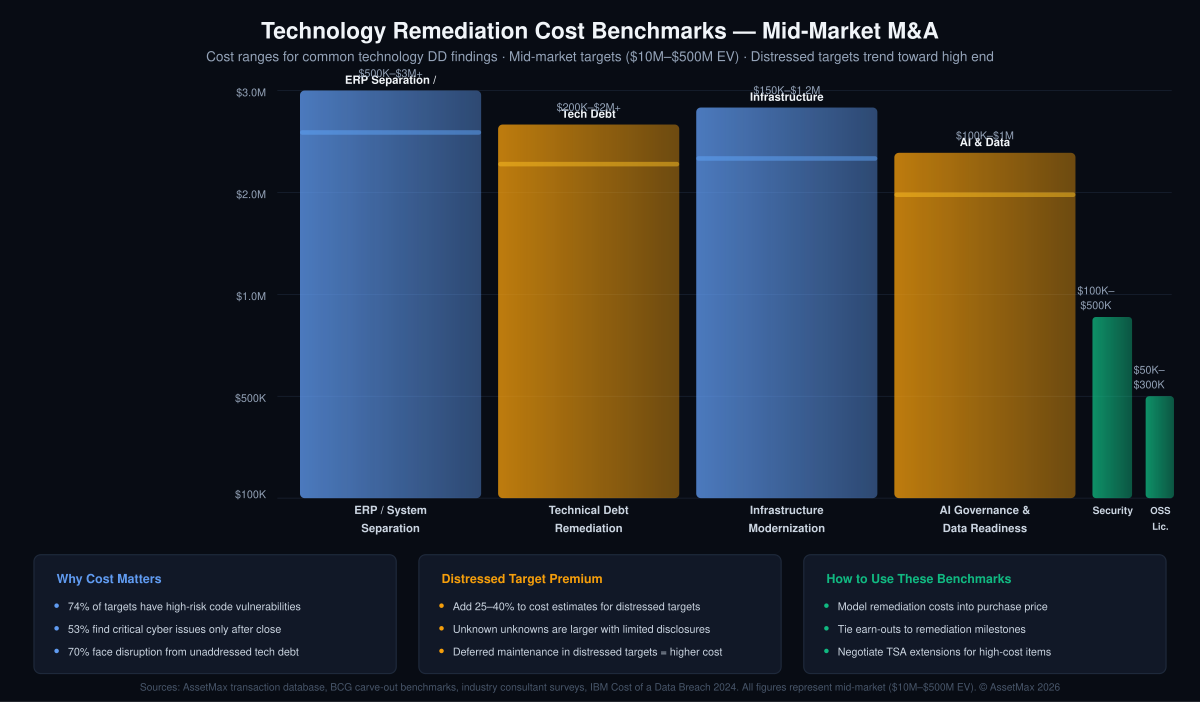
Sources: AssetMax transaction database, BCG carve-out benchmarks, industry consultant pricing surveys. All figures represent mid-market targets ($10M–$500M enterprise value). Distressed targets typically trend toward the high end of these ranges due to deferred maintenance and information gaps.
How to Build Remediation Costs Into Your Bid
Technology remediation costs should flow directly into your deal model — not sit in a separate “IT budget” that gets cut during negotiations. Here’s the framework:
- Quantity the gap. For each of the 7 risk areas, estimate the cost to bring the target to an acceptable baseline (not best-in-class — just investable).
- Prioritize by urgency. Separate Day 1 mandatory spending (security, compliance, key systems stability) from Year 1 improvement spending.
- Build into purchase price adjustments. Use quantified remediation costs as leverage for price reductions, earn-outs tied to remediation milestones, or seller-funded TSA extensions.
- Don’t double-count. If you’re planning an ERP replacement, don’t also budget for extensive ERP remediation. Pick your strategy and cost it accordingly.
- Add the distressed premium. For stressed or distressed targets, add 25–40% to your technology remediation estimates. The unknown unknowns are always larger than expected.
How AI Is Transforming Technology Due Diligence
The traditional approach to technology due diligence — manual code reviews, spreadsheet-based checklists, consultant interviews — is giving way to AI-powered assessment that’s faster, deeper, and more objective. For special situations investors working against compressed timelines, this shift is particularly valuable.
Automated Code Analysis & Technical Debt Detection
AI-powered code analysis tools can scan millions of lines of code in hours — work that would take human reviewers weeks. These tools identify architectural weaknesses, security vulnerabilities, code duplication, and dependency risks with precision that manual review can’t match. For a distressed target with limited documentation, automated analysis often becomes the primary source of truth about what the codebase actually looks like.
AI-Powered Security Vulnerability Scanning
Modern security assessment platforms use machine learning to identify patterns that signature-based scanners miss — zero-day vulnerabilities, misconfigurations, and anomalous behavior patterns. Tools like Praetorian apply AI-driven security scanning specifically tuned for M&A contexts, where the goal isn’t just finding vulnerabilities but quantifying their financial impact on the deal.
Intelligent Document Review & Contract Analysis
Technology due diligence involves reviewing hundreds of documents — license agreements, vendor contracts, IP assignments, compliance certifications. AI-powered document review can surface risks in contracts that human reviewers miss: non-transferable licenses, unfavorable vendor terms, missing IP assignment language. Diligize applies this approach specifically to technology due diligence, combining automated document analysis with structured risk scoring to compress what traditionally takes 3–4 weeks into days.
According to Bain & Company’s 2025 Global Private Equity Report, firms that integrate AI tools into their due diligence process cut assessment time by 40–60% while increasing issue detection rates by an average of 35%. In special situations — where deal timelines are compressed and sellers may not be cooperative — the advantage of AI-powered diligence is even greater.
Why Technology Due Diligence Fails — And How to Get It Right
Having analyzed hundreds of M&A transactions, we’ve identified four recurring patterns that cause technology due diligence to fail. Understanding these patterns is the first step to avoiding them.
Failure Pattern #1: The Checkbox Exercise
Too many investors treat technology due diligence as a compliance exercise — run through a standard checklist, produce a report, file it away. This approach misses the entire point. Technology DD isn’t about generating a document; it’s about understanding whether the technology foundation supports the investment thesis, and if not, what it will cost to get there.
The fix: Start every technology DD engagement by writing down the investment thesis and the technology assumptions embedded in it. If you’re buying for 3x revenue growth in 5 years, explicitly ask: can the current technology stack support 3x transaction volume? If you’re planning four add-on acquisitions, ask: does the architecture support easy integration? Let the thesis drive the questions, not the checklist.
Failure Pattern #2: Too Late, Too Little
Technology due diligence started two weeks before signing will find only the most obvious problems — and miss everything that matters. The most costly technology risks (architectural limitations, deep technical debt, security posture) take time to surface and quantify.
The fix: Start technology DD during the pre-LOI phase, even if it’s limited to external assessment and management interviews. The earlier you identify technology risks, the more leverage you have to negotiate price adjustments, TSA terms, or remediation commitments. For distressed deals, begin technology triage the moment a target enters your pipeline.
Failure Pattern #3: Siloed from Financial & Legal DD
Technology due diligence that doesn’t talk to financial due diligence is a recipe for missed risks. The IT budget line items that finance is reviewing? They tell a story about technology investment — or the lack thereof. The vendor contracts that legal is reviewing? They contain technology risks that legal teams aren’t trained to spot.
The fix: Structure your due diligence so that technology, financial, and legal workstreams share findings weekly. Create a shared risk register where each workstream can flag issues that the others should investigate. The $50,000 annual “IT consulting” line that finance flagged as an outlier? That might be a critical vendor dependency that technology DD needs to assess.
Failure Pattern #4: No Integration Handoff
The most meticulously conducted technology due diligence is worthless if the findings don’t make it into the post-close integration plan. We’ve seen deals where the DD report identified critical security gaps, but the integration team never received the report — and the gaps weren’t addressed until an incident occurred.
The fix: Make technology DD findings the foundation of your Day 1–100 integration plan. Every high-severity finding should map to a specific integration workstream, owner, and deadline. The technology DD lead should participate in the first 30 days of integration planning, not hand off a report and disappear.
FAQ: Technology Due Diligence
What is technology due diligence?
Technology due diligence is the systematic assessment of a target company’s technology assets, infrastructure, software, security posture, and engineering capabilities during an M&A transaction. It validates whether the technology foundation supports the deal’s investment thesis and quantifies the cost to remediate any gaps. In special situations — distressed acquisitions, carve-outs, turnarounds — technology DD also identifies hidden risks that could destroy post-close value.
What does technology due diligence include?
A comprehensive technology due diligence assessment covers seven core areas: (1) infrastructure and architecture, (2) technical debt and code quality, (3) cybersecurity and data protection, (4) intellectual property and licensing, (5) vendor and third-party dependencies, (6) team and talent, and (7) AI and data readiness. Each area requires specific assessment methodologies, and findings should flow directly into deal pricing and post-close integration planning.
How long does technology due diligence take?
For a mid-market acquisition, comprehensive technology due diligence typically takes 3–6 weeks from data room access to final report. However, special situations investors should begin with a rapid pre-LOI technology triage (3–5 days) to identify deal-breakers before committing to a full diligence process. AI-powered assessment tools like Diligize can compress the confirmatory diligence phase by 40–60%, making it possible to complete thorough technology DD even within the compressed timelines of distressed deal processes.
What is an IT due diligence checklist?
An IT due diligence checklist is a structured framework for evaluating a target company’s information technology assets during M&A. A comprehensive checklist covers infrastructure inventory, application assessment, security and compliance review, vendor and licensing audit, team evaluation, and cost estimation. For distressed targets, the checklist should also include TSA dependency mapping, key-person risk assessment, and shadow IT discovery — areas that standard checklists often miss but that carry outsized risk in special situations.
How much does technology due diligence cost?
External technology due diligence services typically cost $30,000–$150,000 for mid-market transactions, depending on target complexity, scope depth, and timeline urgency. Pre-sale technology audits for sellers run lower — typically £8,000–£20,000 per Boardman Advisory. The real cost consideration, however, is not the diligence itself but the savings it enables: identifying a $500,000 ERP migration requirement before closing, or surfacing a cybersecurity gap that would have cost $2 million to remediate post-close, more than justifies the diligence investment.
What are the biggest technology risks in distressed M&A?
The biggest technology risks in distressed M&A are: (1) deferred IT maintenance — years of skipped upgrades, patches, and refreshes that create systemic fragility; (2) key-person dependencies — critical technical knowledge concentrated in one or two people who may leave; (3) TSA dependency gaps — in carve-outs, the target’s ability to operate independently is often overestimated; (4) ransomware and cybersecurity exposure — distressed companies are prime targets for attackers; (5) hidden licensing liabilities — unlicensed software usage that becomes the acquirer’s problem post-close.
What is technical debt, and why does it matter in M&A?
Technical debt is the accumulated cost of shortcuts, deferred improvements, and outdated technology choices in a company’s software and infrastructure. In M&A, technical debt matters because it directly impacts post-close costs and value-creation timelines. Research shows that 70% of deals face operational disruption from unaddressed technical debt. For special situations investors, technical debt remediation can range from $200,000 to $2 million+ per acquisition and should be explicitly modeled into the deal’s financial case rather than treated as a post-close surprise.
Should technology due diligence be different for carve-outs vs. full acquisitions?
Yes — technology due diligence for carve-outs requires additional assessment dimensions that full acquisitions don’t. The primary difference is TSA dependency: carve-out targets often depend on the seller for critical IT services (ERP, network, security, data centers) that must be separated or replaced. Carve-out technology DD must map every dependency, estimate separation costs and timelines, and verify that TSA terms are adequate. BCG recommends six specific imperatives for carve-out technology DD, including scope validation of included technology assets, TSA dependency analysis, and one-time separation cost estimation.
Can AI tools replace human technology due diligence?
AI tools cannot fully replace human technology due diligence — but they can dramatically accelerate and deepen it. AI excels at automated code analysis, vulnerability scanning, document review, and pattern detection across large datasets. Bain & Company reports that firms using AI in their DD process cut assessment time by 40–60% and increased issue detection by 35%. However, AI cannot replace the contextual judgment of experienced technology assessors: interpreting findings against the investment thesis, evaluating team quality, and designing remediation strategies still requires human expertise. The optimal approach combines AI-powered assessment tools with experienced technology DD practitioners.
What happens if you skip technology due diligence?
Skipping technology due diligence is one of the most expensive mistakes an investor can make. The consequences typically include: (1) cost surprises — discovering post-close that an ERP migration costs $2 million that wasn’t in the model; (2) security incidents — 53% of acquirers find critical cybersecurity issues only after closing; (3) integration failures — technology integration problems account for roughly 30% of failed mergers; (4) valuation errors — overpaying for technology assets that need immediate, expensive remediation; (5) regulatory exposure — inheriting compliance violations that create immediate legal liability. For special situations investors, the cost of skipping technology DD is amplified: distressed targets carry more hidden risk, and compressed timelines leave less margin for post-close recovery.
Conclusion: Technology Due Diligence Is Your Deal’s Insurance Policy
Technology due diligence isn’t about generating reports. It’s about protecting returns. Every dollar spent on thorough technology assessment before closing saves multiples in post-close remediation, operational disruption, and deal value erosion.
For special situations investors, the case is even stronger. You operate in a market where targets carry more technology risk, timelines are tighter, and the margin for error is smaller. The question isn’t whether you can afford to do technology due diligence — it’s whether you can afford not to.
With AI-powered assessment tools like Diligize for technology due diligence, Praetorian for cybersecurity assessment, and CarveX for carve-out IT separation planning, AssetMax provides the technology assessment infrastructure that special situations investors need to execute with confidence at the speed distressed deals demand.
Ready to strengthen your technology due diligence process? Contact AssetMax to learn how our AI-powered assessment platform can accelerate your deal evaluation and protect your returns.